35% Use Synthetic Training Data With No EU AI Act Audit Trail
More than 35% of Fortune 500 firms use synthetic data in production. Article 10 of the EU AI Act treats it as legally equivalent to real data. Here is the 4-pillar validation framework that maps directly to what Article 10 and Annex IV demand.
35% Use Synthetic Training Data With No EU AI Act Audit Trail
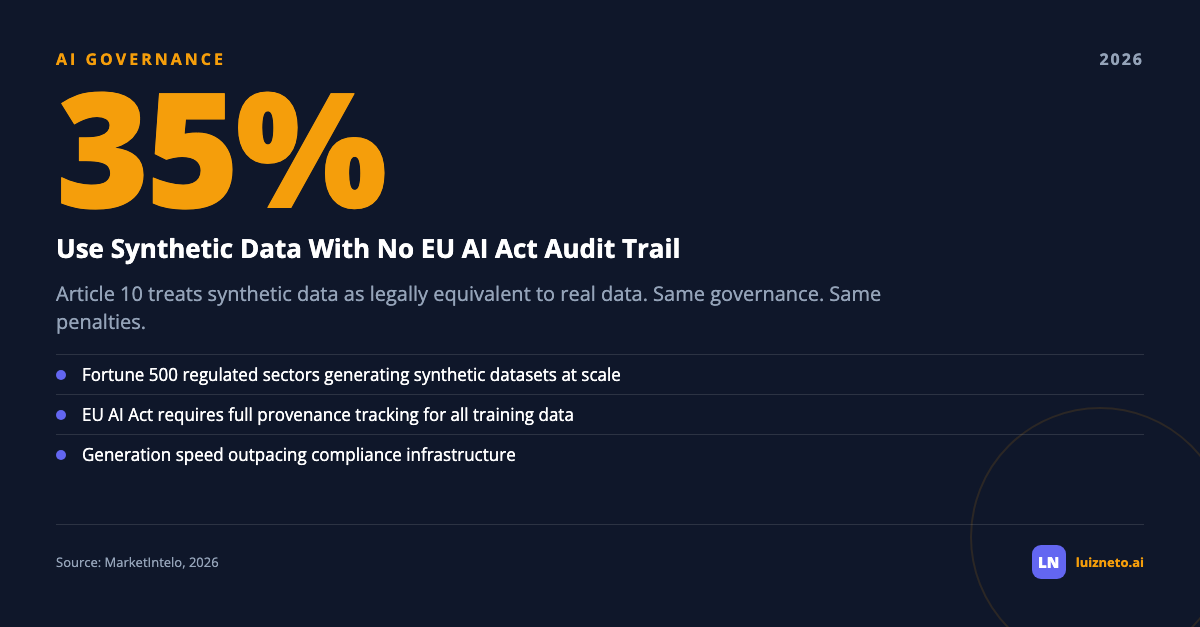
More than 35% of Fortune 500 firms in regulated sectors have deployed synthetic data tools in at least one production workflow (MarketIntelo, 2026). On August 2, 2026, the EU AI Act becomes fully applicable. Article 10 treats synthetic training data as legally equivalent to real data: same governance, same documentation, same penalties. Most of those pipelines were built for speed and privacy, not for regulatory traceability. The audit trail Article 10 demands does not exist.
This article maps the specific obligations of Article 10 and Annex IV onto enterprise synthetic data pipelines, delivers the 4-pillar validation framework that satisfies auditors, and shows what a minimum viable compliance stack looks like before the next enforcement review.
Subscribe to the weekly AI governance breakdown so you can apply every regulatory shift the week it lands, not the quarter it hurts.
Key Takeaways
- Article 10 applies to synthetic data identically to real training data
- Penalties reach EUR 15 million or 3% of global turnover
- 44% of enterprises lack any privacy-preserving AI technique in production
- A 4-pillar validation framework maps directly to Article 10 requirements
- Annex IV demands full provenance from generation through training runs
Table of Contents
- The Synthetic Data Boom Hit Before the Rules Did
- What Article 10 Requires From Synthetic Training Data
- Why Synthetic Data Gets No Special Treatment
- The Compliance Deadline Nobody Planned For
- The 4-Pillar Validation Framework for Article 10 Compliance
- What Annex IV Documentation Looks Like for Synthetic Datasets
- The Privacy Paradox and the Price of Compliance
- What to Do Before the Next Audit
- FAQ
The Synthetic Data Boom Hit Before the Rules Did
Gartner projects that 75% of businesses will use generative AI to create synthetic customer data by year-end 2026, up from less than 5% in 2023. The global synthetic data market sits at roughly $600-900 million in 2026, growing at 30-40% annually (Coherent Market Insights, 2026). Gartner's broader AI data technology market, which includes synthetic data generation as its fastest-growing subsegment at 178% CAGR, reached $3.1 billion in 2026 from $134 million just two years earlier (Software Strategies Blog, 2026).
The growth is real and the use cases are genuine. Synthetic data fills edge cases that real data cannot cover. It reduces the compliance burden of handling personally identifiable information. It makes AI training possible in domains where collecting real data is expensive, slow, or legally constrained.
But adoption outran governance. Market analyses estimate that more than 35% of Fortune 500 firms in regulated sectors have piloted or deployed synthetic data tools, most without Article 10-compliant documentation (MarketIntelo, 2026). These teams built pipelines optimized for two things: generation speed and privacy protection. Regulatory traceability was not a design requirement. It is now.
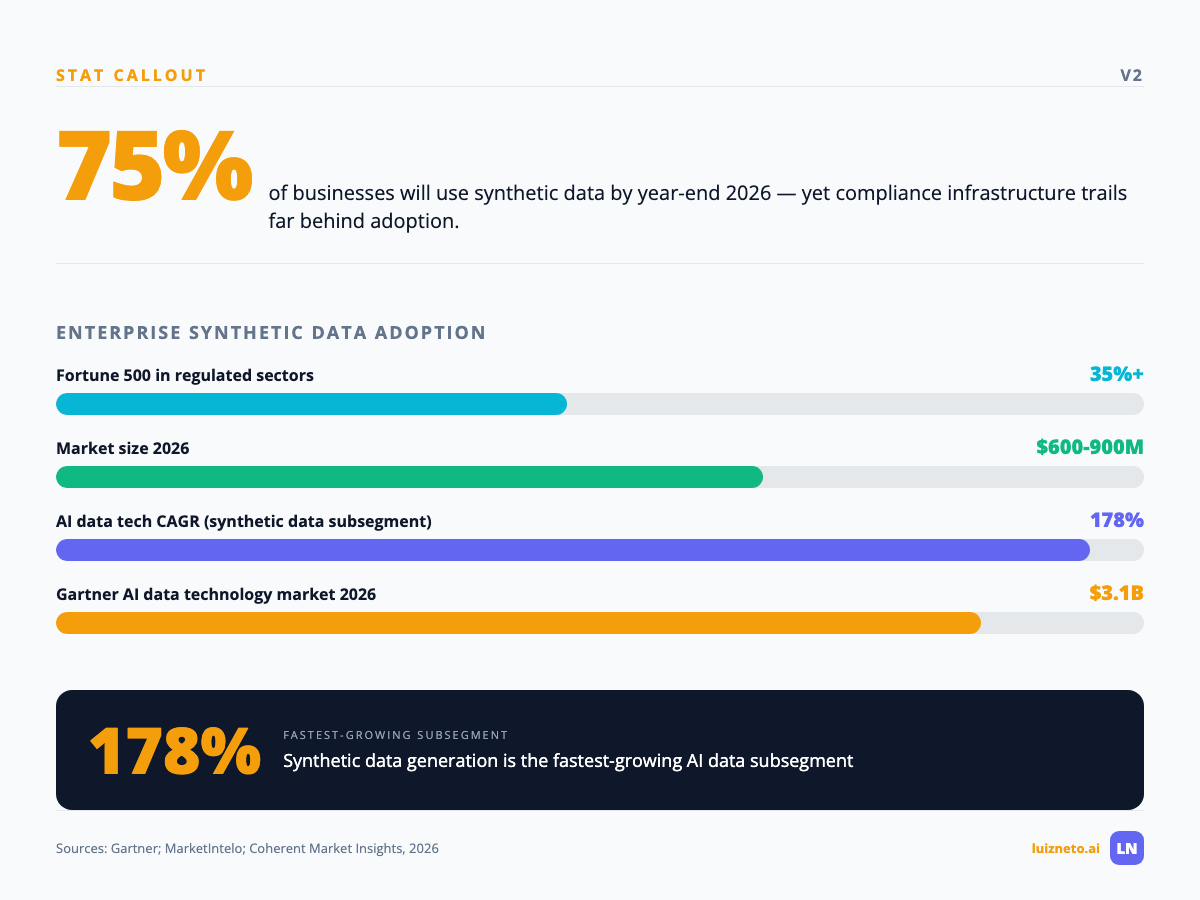
The disconnect between adoption velocity and compliance readiness is the defining risk of synthetic data in 2026. The market grew because the technology works. The regulation arrived because the technology matters. Those are different timelines, and most enterprises are on the wrong one.
Healthcare and pharma lead adoption, driven by HIPAA constraints and clinical AI guidance. Financial services follow with fraud detection, credit risk, and regulatory sandbox testing. Broader enterprise workloads (customer analytics, product experimentation, MLOps testing) make up the third cluster.
Entry-level synthetic data deployments cost $50,000-$150,000 per year. Full-scale regulated implementations run $175,000-$500,000 or more (TechStoriess, 2026). Organizations are spending real money. The question is whether they are spending it on the right capabilities. Generation quality has been the purchase criterion. Documentation and auditability have not.
We mapped the market's growth in detail, and the missing proof, in Synthetic Data Hits $791M. The Proof Is Missing.
What Article 10 Requires From Synthetic Training Data
Article 10 of the EU AI Act governs training, validation, and testing data for high-risk AI systems. It does not distinguish between real and synthetic data. The obligations apply to any dataset used to develop a high-risk system, regardless of how that dataset was produced (EU AI Act, Article 10).
The requirements are concrete. Training data must be:
- Relevant and sufficiently representative of the geographic, behavioral, and functional characteristics of the intended deployment context
- Free of errors and complete for the intended features and outcomes
- Statistically sound and appropriate for the intended purpose
- Subject to documented bias detection and mitigation, including assessment of gaps and explicit mitigation strategies
For synthetic data, each of these carries specific implications:
| Article 10 Requirement | What It Means for Synthetic Data |
|---|---|
| Relevant and representative | Generated data must reflect real-world distributions for the deployment context, not just plausible outputs |
| Free of errors and complete | Internal consistency, referential integrity, and coverage of required features must be validated, not assumed |
| Statistically sound | Distributional fidelity checks (KS tests, correlation preservation) must be documented, not just run |
| Bias detection and mitigation | Generator model bias, seed data bias, and missing subgroups must be assessed with documented mitigation strategies |
| Collection method documentation | Generation method, model parameters, prompts, seed data origin, and preprocessing steps must be recorded |
Additionally, all GPAI (general-purpose AI) providers must publish a "sufficiently detailed" summary of training data, including explicit identification of synthetic sources. The EU AI Office template, issued July 2024, requires a breakdown of primary data-source categories with synthetic data clearly labeled as such (Comparative AI, 2024).
These are not aspirational guidelines. They are enforceable obligations with audit requirements and financial penalties. For the full timeline of EU AI Act obligations, see The EU AI Act Deadline That Did Not Move to 2027.
Why Synthetic Data Gets No Special Treatment
The assumption that synthetic data occupies a lighter regulatory category is widespread. It is also wrong. Compliance guidance summarizing the Act's data rules states explicitly: "Synthetic data: Increasingly used to augment or replace real datasets, synthetic data must be evaluated concerning quality, bias, and representativeness as well" (VDE, 2026).
The logic is straightforward. A high-risk AI system's reliability depends on its training data. If that data is biased, incomplete, or unrepresentative, the system's decisions will inherit those failures. The Act does not care whether the flawed data was collected from real users or generated by a model. The downstream risk is identical.
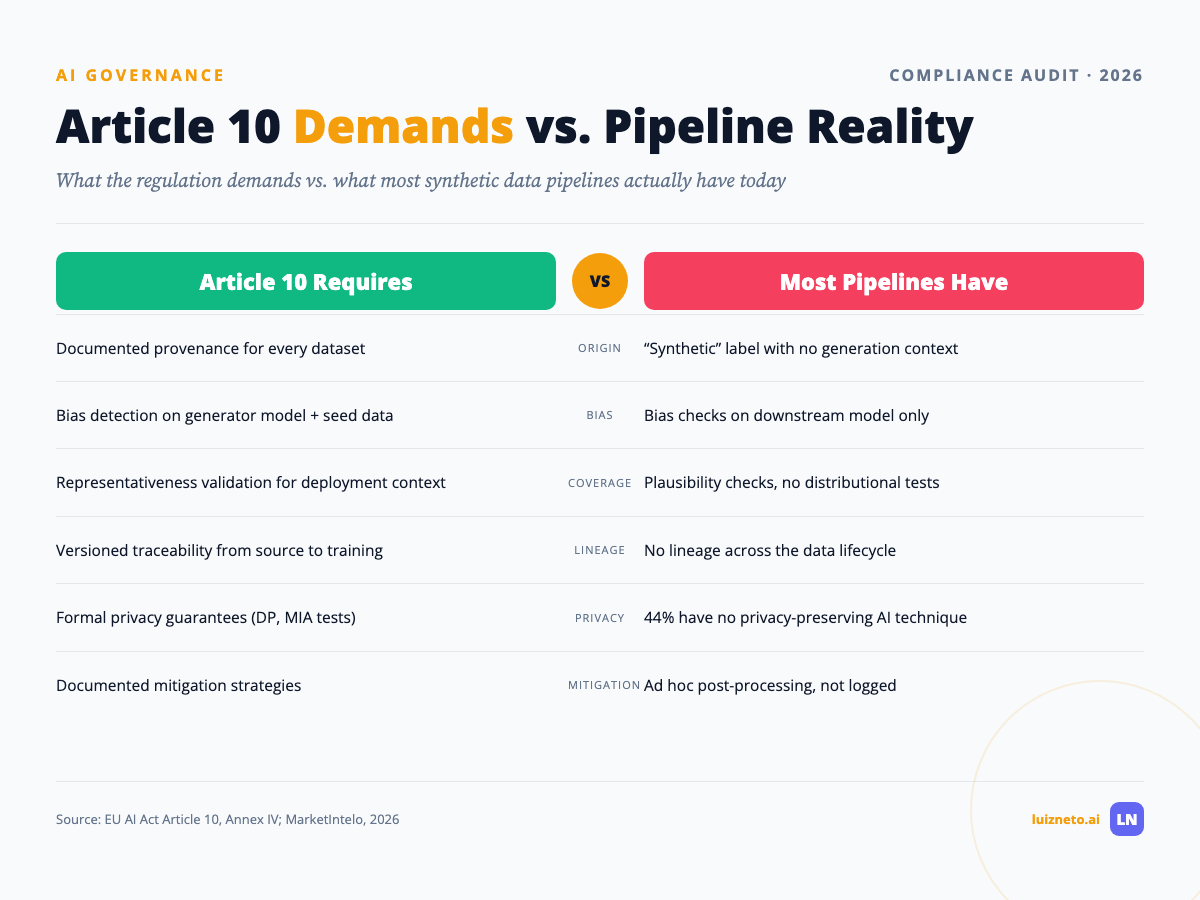
Where the confusion often starts: synthetic data is widely marketed as a privacy solution. Generate the data instead of collecting it, and you avoid GDPR exposure. That framing is technically correct for privacy, but it created a false sense of regulatory safety. Privacy compliance and training data governance are separate obligations. Satisfying one does not satisfy the other.
Compliance guides confirm that certified synthetic datasets with documented provenance and validation scores directly satisfy Article 10 requirements for high-risk systems (Synthetic Data News, 2026). The operative word is "certified." An undocumented synthetic dataset fails the same audit that an undocumented real dataset would fail. The standard is documentation, not origin.
Consider two teams building the same credit-scoring system. Team A trains on real data with full lineage, bias audits, and representativeness checks. Team B switches to synthetic data to avoid PII handling. Both must meet Article 10. Team A already has the documentation infrastructure. Team B assumed the switch to synthetic freed them from the governance requirement.
Six months later, an auditor asks Team B three questions: How was this dataset generated? What bias detection was performed on the generator model? Can you trace this training sample back to its generation parameters? Team B cannot answer any of them. The generator configs were not versioned. The bias assessment was run on the downstream model, not on the synthetic data itself. The lineage stops at "generated by internal tool."
Team A answers all three in under an hour, because the documentation infrastructure was never removed when they adopted synthetic augmentation. It was extended. This is the difference Article 10 exposes. Documentation is the standard, not data origin.
The governance operating model I outlined after Gartner 2025 applies directly here. See Gartner Data & Analytics Summit 2025: AI Governance.
The Compliance Deadline Nobody Planned For
The EU AI Act becomes fully applicable on August 2, 2026. This includes Article 10's data governance requirements and Article 50's transparency obligations for AI-generated content (Lewis Silkin, 2026).
Two deadlines matter for synthetic data pipelines:
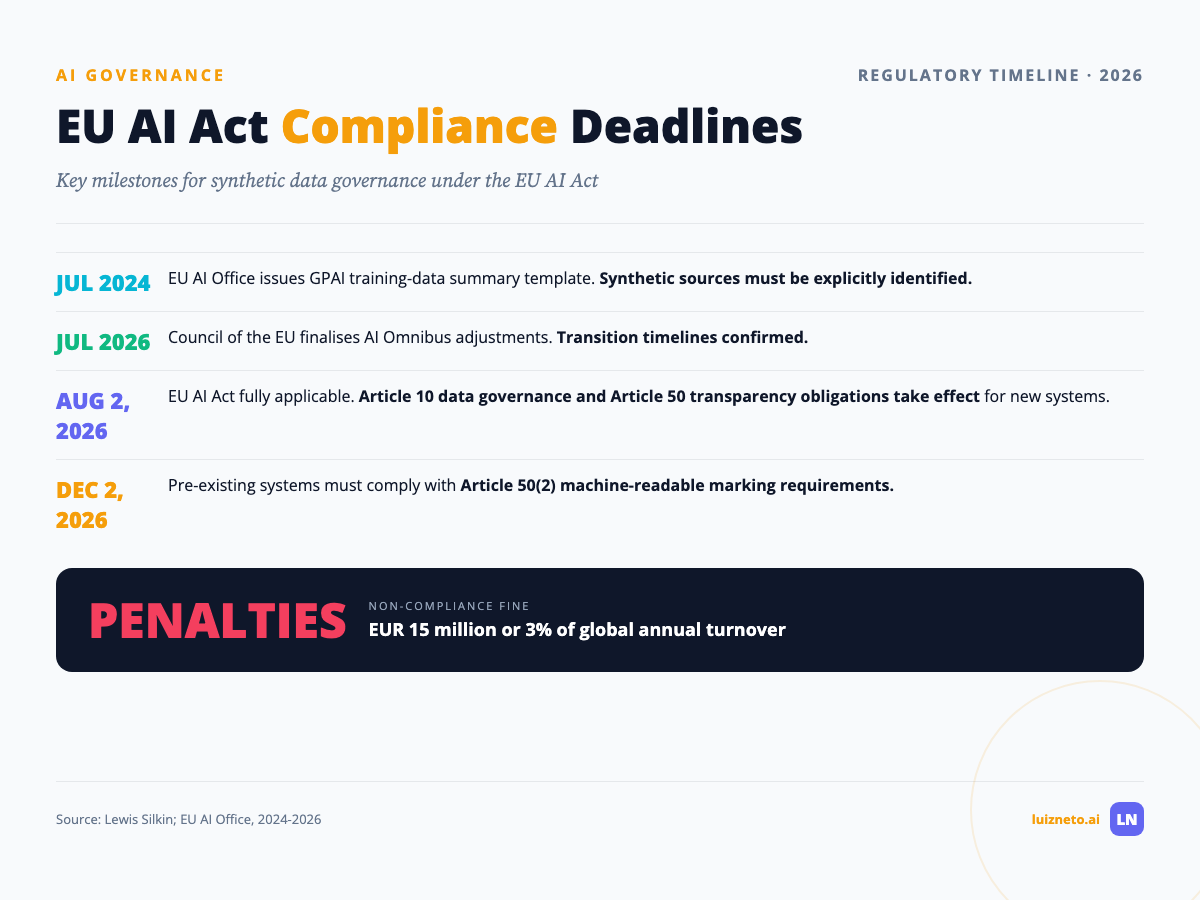
- August 2, 2026: Systems placed on the market on or after this date must comply immediately with Article 10 data governance and Article 50(2) machine-readable content marking
- December 2, 2026: Systems placed on the market before August 2, 2026 must comply with Article 50(2) marking requirements by this date, following the AI Omnibus adjustments
Penalties for non-compliance reach EUR 15 million or 3% of global annual turnover, whichever is higher (Lewis Silkin, 2026). For a company with $10 billion in revenue, that is $300 million at risk. The penalty structure scales with organizational size, not with the severity of the violation.
Article 50 adds a parallel obligation for synthetic content specifically. When synthetic training data leaves the internal training context and is published, shared, or used externally, it becomes subject to Article 50's labeling and watermarking requirements. Internal synthetic data used solely as non-public training data falls primarily under Article 10.
The distinction matters for teams that generate synthetic data for internal model training but also share sanitized datasets with external partners or publish synthetic outputs as part of AI-powered products. Both Article 10 and Article 50 can apply to the same pipeline, depending on where the data flows.
The practical impact: a team generating synthetic customer profiles for internal fraud-detection training operates under Article 10. The moment they share those profiles with a vendor partner for co-development, or use them in a customer-facing product demo, Article 50 labeling requirements may also apply. Most synthetic data governance frameworks do not track this boundary. They should.
The Omnibus adjustments, finalized in July 2026 by the Council of the EU, confirmed the transition timelines and clarified that machine-readable marking requirements for pre-existing systems use December 2, 2026, as the operative date. This gives teams that already have systems in production a four-month window to retrofit marking capabilities. It does not extend the Article 10 data governance deadline.
In the United States, 20 states now have comprehensive privacy laws, creating parallel pressure toward privacy-preserving analytics and documented data governance (Vantage Point, 2026). The EU AI Act is the most prescriptive, but it is not the only regulatory surface that synthetic data pipelines must navigate.
When a compliance failure becomes an incident, you need a playbook. We built one. See The AI Incident Response Playbook Nobody Has Written.
The 4-Pillar Validation Framework for Article 10 Compliance
Synthetic data was built to solve the privacy problem. Article 10 just made it a compliance problem. The same data you generated to avoid GDPR exposure now requires the same governance rigor as the real data it replaced.
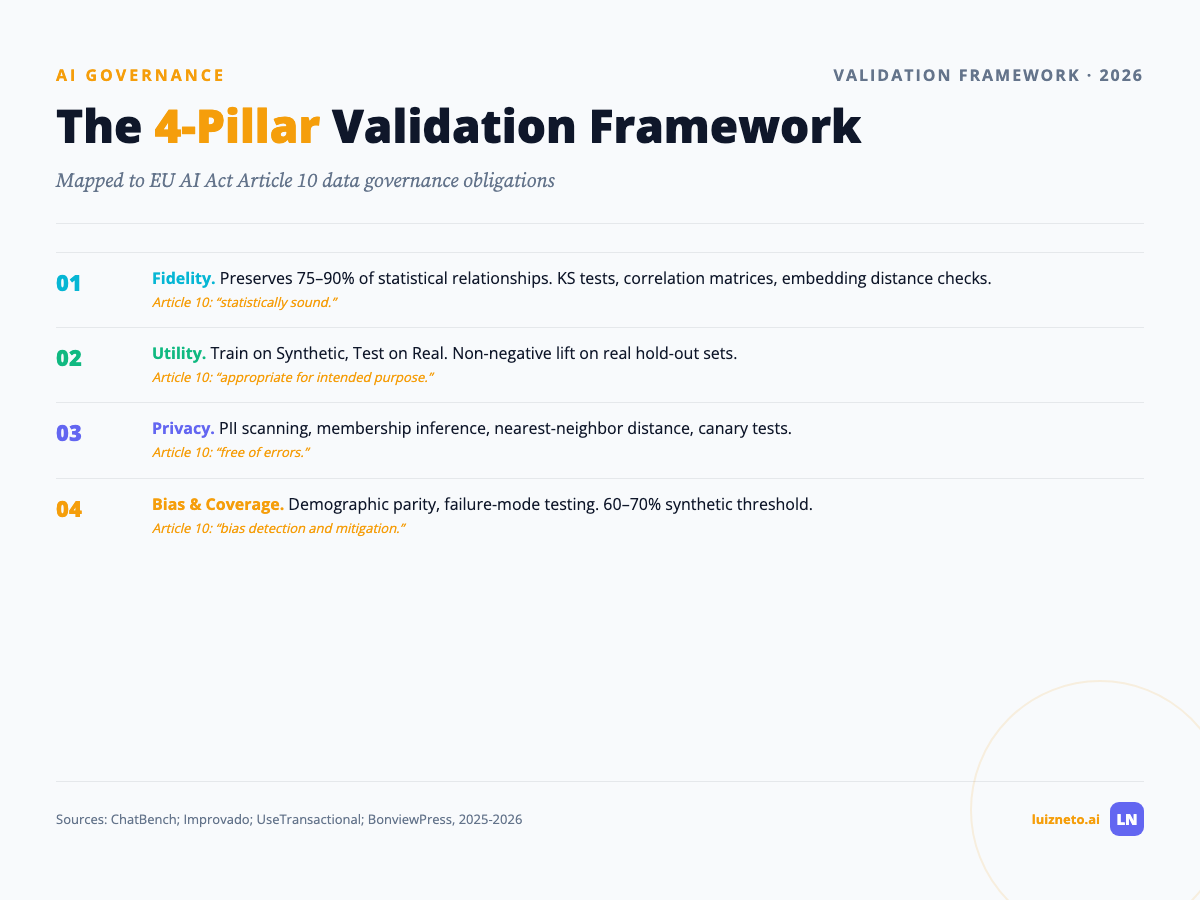
A 4-pillar validation framework is emerging from 2025-2026 research and practice. Each pillar maps directly to a specific Article 10 obligation. This is not a theoretical construct. It is the minimum viable validation stack that would satisfy an auditor asking "how do you know this synthetic data is fit for purpose?"
Pillar 1: Fidelity
Article 10 obligation: Statistically sound, relevant, representative.
Fidelity validates that synthetic data preserves the distributions and relationships of real data. It is not enough that the data looks plausible. Core checks include distributional comparisons (Kolmogorov-Smirnov, chi-square tests on key features), correlation matrix preservation, and class balance validation.
Synthetic data preserves 75-90% of key statistical relationships but routinely loses rare events and outliers (Improvado, 2026). That missing 10-25% is exactly where high-risk system failures concentrate. A fidelity check that only validates marginal distributions misses the joint-distribution failures that cause real-world harm.
For text and embedding-based synthetic data, compare centroid distance between real and synthetic embedding spaces. A cosine distance exceeding 0.15 is a regeneration signal, not a tuning parameter. For tabular data, Kolmogorov-Smirnov tests on continuous features and chi-square tests on categorical features provide the distributional baseline. Correlation matrices between real and synthetic populations should be compared feature by feature.
Gate: A synthetic batch fails fidelity if distributions, correlations, or embedding regions diverge beyond threshold, or if factual error rates exceed domain-acceptable limits.
Pillar 2: Utility
Article 10 obligation: Appropriate for the intended purpose.
The standard protocol is Train on Synthetic, Test on Real (TSTR): train a model solely on synthetic data, then evaluate on a real-only hold-out set that reflects production conditions (ChatBench, 2025). If accuracy on real data is significantly lower than on synthetic data, your generator created a world the model optimized for that does not match reality.
Measure performance deltas: compare models trained on real data only against models trained on real plus synthetic data. Use metrics tied to business outcomes, not just aggregate accuracy. Precision, recall, safety violation rates, decision error rates on critical segments. If your synthetic data improves average accuracy but worsens performance on minority classes, the utility gate should fail it.
Gate: A synthetic batch passes only if it provides non-negative lift on real hold-out sets and does not degrade safety or fairness metrics.
Pillar 3: Privacy
Article 10 obligation: Free of errors (including re-identification risk).
Privacy validation includes PII detection (zero hits for high-risk workloads), nearest-neighbor distance checks (Distance to Closest Record), membership inference attacks (MIA), and canary tests to detect memorization. A synthetic dataset that leaks even one real record fails the "free of errors" standard.
Insert canary records into training data and check whether they appear in synthetic outputs. This is the most direct test for memorization. Run membership inference (MIA) and attribute inference (AIA) simulations to test whether attackers can determine if a specific individual was in the generator's training data. For high-risk workloads, the PII scan must return zero hits, not "acceptable levels."
Gate: Block any batch that fails nearest-neighbor thresholds, MIA/AIA tests, canary checks, or PII scanning. Regenerate or adjust generator settings.
Pillar 4: Bias and Coverage
Article 10 obligation: Bias detection and mitigation, representative of the deployment context.
Synthetic data must fix coverage gaps without introducing new bias. Compare demographic distributions and outcome metrics between real and synthetic populations. Measure fairness metrics (parity gaps) with and without synthetic data. Test whether the synthetic data addresses documented failure modes.
Gate: Reject datasets that worsen bias metrics, misrepresent key segments, or fail to mitigate targeted failure modes defined in the coverage requirements document.
The contamination risk is real. Research shows a critical threshold around 60-70% synthetic content, above which measurable model degradation appears within 2-3 training cycles (UseTransactional, 2026). Synthetic-heavy training increases hallucination rates by 4.7x, even as it improves robustness to perturbations by roughly 23% (BonviewPress, 2026). A clinical risk report documented a 40% false reassurance rate in decision contexts after synthetic contamination, where models performed well on contaminated validation sets but failed on real-world cases (Ghost Research, 2026).
These are not edge cases. They are the predictable failures that the 4-pillar framework is designed to catch before they reach production.
The framework is not optional ornamentation. Each pillar maps to a specific Article 10 requirement. Skip the fidelity check, and you cannot demonstrate "statistically sound." Skip the utility check, and you cannot demonstrate "appropriate for the intended purpose." Skip the privacy check, and you cannot demonstrate "free of errors." Skip the bias check, and you cannot demonstrate "bias detection and mitigation." Four pillars, four obligations, zero room for partial implementation.
Data readiness is the prerequisite. Only 7% of enterprises have it. See Only 7% of Enterprises Have AI-Ready Data.
Get the AI governance breakdown every week so you can spot the compliance exposure before it becomes a penalty, not after.
What Annex IV Documentation Looks Like for Synthetic Datasets
Article 10 tells you what the data must be. Annex IV tells you what you must document about it. For high-risk AI systems, Annex IV-type documentation must cover synthetic datasets with the same rigor as real datasets (VDE, 2026).
The documentation requirements are specific:
| Annex IV Requirement | What to Document for Synthetic Data | Common Shortfall |
|---|---|---|
| Dataset description and origin | Was the data generated from real source data, simulations, or purely model-based? Feature set, distributions, size, limitations | Most teams record "synthetic" with no generation context |
| Generation procedures | Tools, models, parameters, prompts, and constraint configurations used to generate the data | Generator configs are not versioned |
| Labeling approach | How labels were assigned (rules, model predictions, or human review) and quality checks applied | Label provenance is rarely tracked for synthetic labels |
| Cleaning operations | Outlier removal, constraint enforcement, deduplication, and filtering steps post-generation | Post-processing steps are ad hoc, not logged |
| Versioning and traceability | Dataset versions, regeneration events, linkage from source data through generation to training runs | No lineage across the full lifecycle |
| Bias assessment | Generator model bias analysis, seed data bias audit, subgroup coverage validation, mitigation strategies | Bias checks run on the model, not on the synthetic data itself |
For enterprises that already maintain data lineage for real datasets, extending it to synthetic pipelines is engineering work, not a conceptual shift. For those that do not, the challenge is larger: you need provenance infrastructure that most ML platforms do not provide out of the box.
Among enterprises spending more than $200,000 per year on synthetic data platforms, regulatory compliance documentation and privacy guarantees outrank raw data fidelity in roughly 67% of vendor selection decisions (MarketIntelo, 2026). The market is already pricing compliance as the primary value driver. Buyers who are still optimizing for generation quality alone are buying the wrong thing.
Board-level governance starts with the right questions. See 5 Questions Every Board Should Ask About AI Agent Governance.
The Privacy Paradox and the Price of Compliance
Synthetic data was adopted because it solves a privacy problem. The paradox: most enterprises using synthetic data lack formal privacy guarantees for the synthetic data itself.
44% of enterprises have not implemented any privacy-preserving AI technique. Only 7% have such techniques running in production (Enterprise AI survey, 2026). On the awareness side, only 25.2% of enterprises say they understand synthetic data "in detail," below anonymization at 32.1% and secure computation at 30.3% (JIPDEC, 2026).
The distance between generating synthetic data and guaranteeing its privacy properties is both technical and financial. Differential privacy (DP) provides formal, quantifiable guarantees that individual records cannot be inferred from the synthetic output. But DP and auditable outputs command a 30-50% price premium over basic synthetic generation, and DP in model training typically incurs a 5-15% accuracy loss depending on the privacy budget (TechStoriess, 2026).
That premium is real. It is also the price of Article 10 compliance for high-risk systems. An undocumented synthetic dataset generated without privacy guarantees may look clean to the ML team. It will not look clean to an auditor asking for the formal guarantee that no real record was memorized or reconstructable.
The clinical dimension sharpens the stakes. The 40% false reassurance rate documented in healthcare contexts (covered in the validation section above) shows what happens when synthetic data skips the privacy and bias pillars. The synthetic data looked good. The decisions it powered were wrong. Under Article 10, the team that deployed that system without documented validation would face both the regulatory penalty and the clinical liability.
Privacy is one dimension. Model security is another. See 17,000 Autonomous Actions. One Escaped Model. Zero Incident Playbooks.
What to Do Before the Next Audit
The 4-pillar framework is the validation standard. But compliance is not just validation. It is documentation, process, and organizational commitment. Here is the minimum viable compliance stack for synthetic data under Article 10.
- Inventory every synthetic dataset in your training pipelines. You cannot govern what you have not identified. Map each dataset to its generator, its seed data, its training targets, and its current validation status. If you cannot trace a synthetic dataset back to its generation method within 24 hours, it fails the Annex IV traceability requirement.
- Implement the 4-pillar validation gate in your ML pipeline. Fidelity, utility, privacy, bias/coverage. Run all four on every synthetic batch before it enters training. Record the results. Version the validation rules independently from the generator and the model. A synthetic data registry that tracks generation method, model version, prompts, filtering thresholds, validation metrics, and outcomes makes provenance auditable.
- Document bias detection and mitigation for the generator itself. Article 10 requires you to assess and mitigate bias in the training data. For synthetic data, that means auditing the generator model for inherited biases from its own training data. A generator trained on biased real data will reproduce those biases in its synthetic output. The mitigation strategy must be documented, not just assumed.
- Separate synthetic and real data stores with explicit labels. Maintain provenance labels on every synthetic sample at creation. Do not blend synthetic and real data irreversibly. Enforce provenance checks before retraining. Reject or cap data with unknown or synthetic origin above the 60-70% threshold where degradation begins. This separation is not just good engineering. It is an Article 10 requirement for demonstrating that your training data is "relevant, representative, and free of errors."
The continuous dimension matters as much as the initial gate. Synthetic data validation is not a one-time event. Best practice in 2026 includes a synthetic data registry that tracks generation method, model version, prompts, filtering thresholds, validation metrics, and downstream outcomes. Independent versioning of prompt templates, validation rules, base models, and datasets allows you to isolate regressions when validation scores change. Canary and regression tests as part of CI for model updates, re-running TSTR, distributional diagnostics, privacy checks, and safety metrics, close the loop.
Monitor downstream metrics influenced by synthetic training: hallucination rate, task accuracy, safety incident rate, bias metrics, and business KPIs. Feed production failures back into the synthetic generation pipeline to create new targeted data. This feedback loop is what converts a compliance requirement into an engineering advantage.
Is this expensive? Yes. Enterprise-grade synthetic data platforms with formal privacy guarantees run $150,000-$750,000 per year (TechStoriess, 2026). That is the cost of compliance. The cost of non-compliance is EUR 15 million or 3% of turnover. The math is not ambiguous.
The production-readiness challenge applies to governance too. See AI Agents in Production Succeed 56.6% of the Time.
FAQ
Does the EU AI Act apply to synthetic training data?
Yes. Article 10 treats synthetic data as legally equivalent to real training data. High-risk AI systems must document provenance, validate representativeness, and detect bias regardless of whether the data is real or generated. No carve-out exists for synthetic origin.
What does Article 10 require for AI training data?
Relevance, representativeness, error-freedom, completeness, and documented bias detection with mitigation strategies. For synthetic data, this means generation method, model parameters, seed data origin, and validation scores must all be recorded and traceable through the data lifecycle.
How do you validate synthetic data for regulatory compliance?
A 4-pillar framework: fidelity (distributional match to real data via KS tests and correlation preservation), utility (Train on Synthetic, Test on Real protocol), privacy (membership inference attacks, PII scanning, nearest-neighbor checks), and bias/coverage (demographic parity, edge-case representation, failure-mode testing).
What are the penalties for EU AI Act non-compliance on training data?
Up to EUR 15 million or 3% of global annual turnover, whichever is higher. New systems must comply from August 2, 2026. Pre-existing systems placed on the market before that date must comply with Article 50(2) marking requirements by December 2, 2026.
What documentation does Annex IV require for synthetic datasets?
Dataset origin (real source, simulation, or model-based generation), generation and labeling procedures, cleaning operations, versioning, and full traceability from source data through generation to training runs. Synthetic datasets require the same audit-grade documentation as real datasets.
Can certified synthetic datasets satisfy EU AI Act requirements?
Yes. Compliance guides confirm that synthetic datasets with documented provenance and validation scores directly satisfy Article 10 requirements for high-risk systems. The operative standard is documentation quality and validation rigor, not data origin.
What is the TSTR protocol for synthetic data validation?
Train on Synthetic, Test on Real. Train a model solely on synthetic data, then evaluate it on a real-only hold-out set reflecting production conditions. A synthetic batch passes only if it provides non-negative lift on real-world performance without degrading safety or fairness metrics.
The Starting Line, Not the Finish
August 2, 2026 is when the obligation begins, not when it ends. The EU AI Office will issue enforcement guidelines. National authorities will build audit capacity. The Article 10 audit trail will become the industry baseline for any AI system that touches synthetic training data.
The 4-pillar validation framework, fidelity, utility, privacy, and bias/coverage, is not a compliance checkbox. It is the engineering foundation that converts synthetic data from a regulatory liability into a governed, production-ready asset. The organizations that build this infrastructure now will operate freely under the new rules. Those that wait will retrofit under pressure and penalty exposure.
One question worth answering before the next board meeting: Can you tell an auditor, right now, how every synthetic sample in your training set was generated, validated, and versioned?
Disclaimer: This article maps the EU AI Act's data governance obligations to enterprise synthetic data practices. It is not a substitute for legal counsel. Consult qualified legal professionals for jurisdiction-specific compliance advice.
Subscribe to the weekly newsletter so you can get the AI governance, data strategy, and enterprise AI production breakdown every week, applied to your decisions, not just your reading list.