Synthetic Data Hits $791M. The Proof Is Missing.
The synthetic data market reaches $791M in 2026. Only 4 of 17 academic surveys provide reproducible quality artifacts. 58.8% of validation concentrates in healthcare. Three validation gates separate scaling from guessing at scale.
Synthetic Data Hits $791M. The Proof Is Missing.
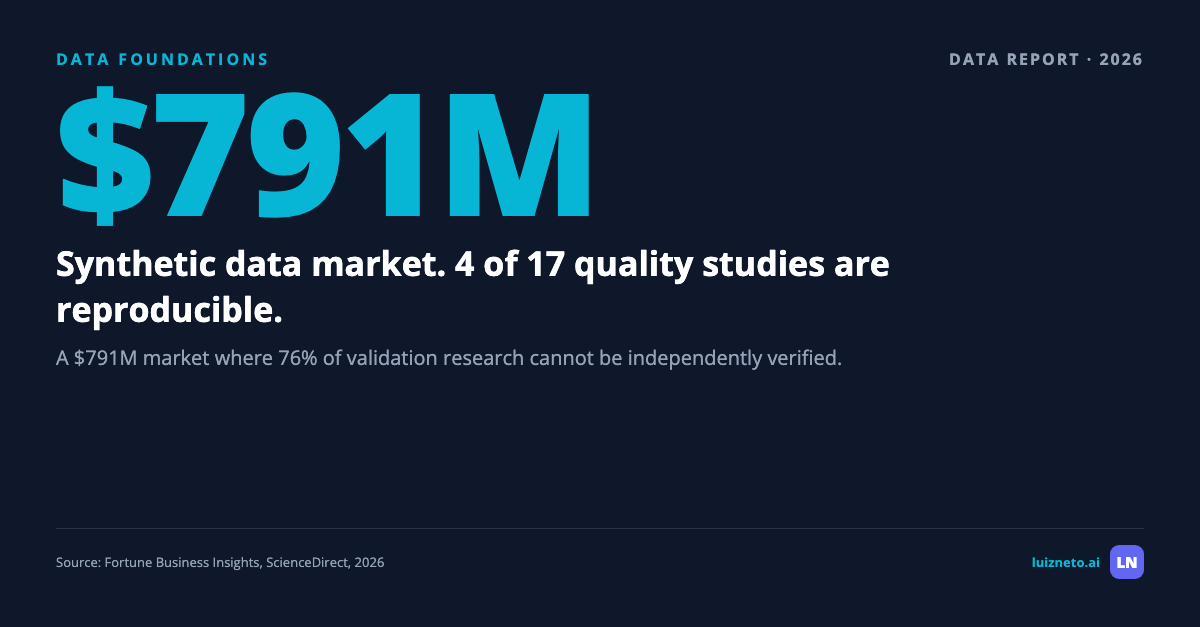
The global synthetic data market will reach $791 million in 2026, growing at 31.1% a year (Fortune Business Insights). On average, 25% of enterprise test data is now generated synthetically (World Quality Report 2025-26). And only 4 of 17 academic surveys evaluating synthetic data quality provide reproducible artifacts (ScienceDirect, 2026).
That is a $791M market built on a quality problem nobody measures. Enterprises generate more of it every quarter. The infrastructure to prove it is any good has not kept pace. This article names the three validation gates your pipeline needs before it touches production AI.
Subscribe to the weekly brief for the numbers, frameworks, and governance questions your AI roadmap is about to face.
Key Takeaways
- Synthetic data reaches $791M in 2026 with 31.1% annual growth
- Only 4 of 17 quality studies provide reproducible validation
- Model collapse is now a measured, not theoretical, production risk
- Production model failures take an average of 11 days to detect
- Three validation gates separate scaling from guessing at scale
Table of Contents
- The $791M Synthetic Data Market Is Real
- Why Enterprises Adopted Synthetic Data
- The Validation Gap Nobody Named
- Model Collapse Is a Production Risk
- The 11-Day Blind Spot
- What GDPR and the EU AI Act Require
- The Three Validation Gates
- FAQ
The $791M Synthetic Data Market Is Real
$603.6 million in 2025. $791.3 million in 2026. A 31.1% compound annual growth rate projected through 2034 (Fortune Business Insights). The market is not speculative. It is growing faster than most enterprise software categories, and faster than the infrastructure meant to validate what it produces.
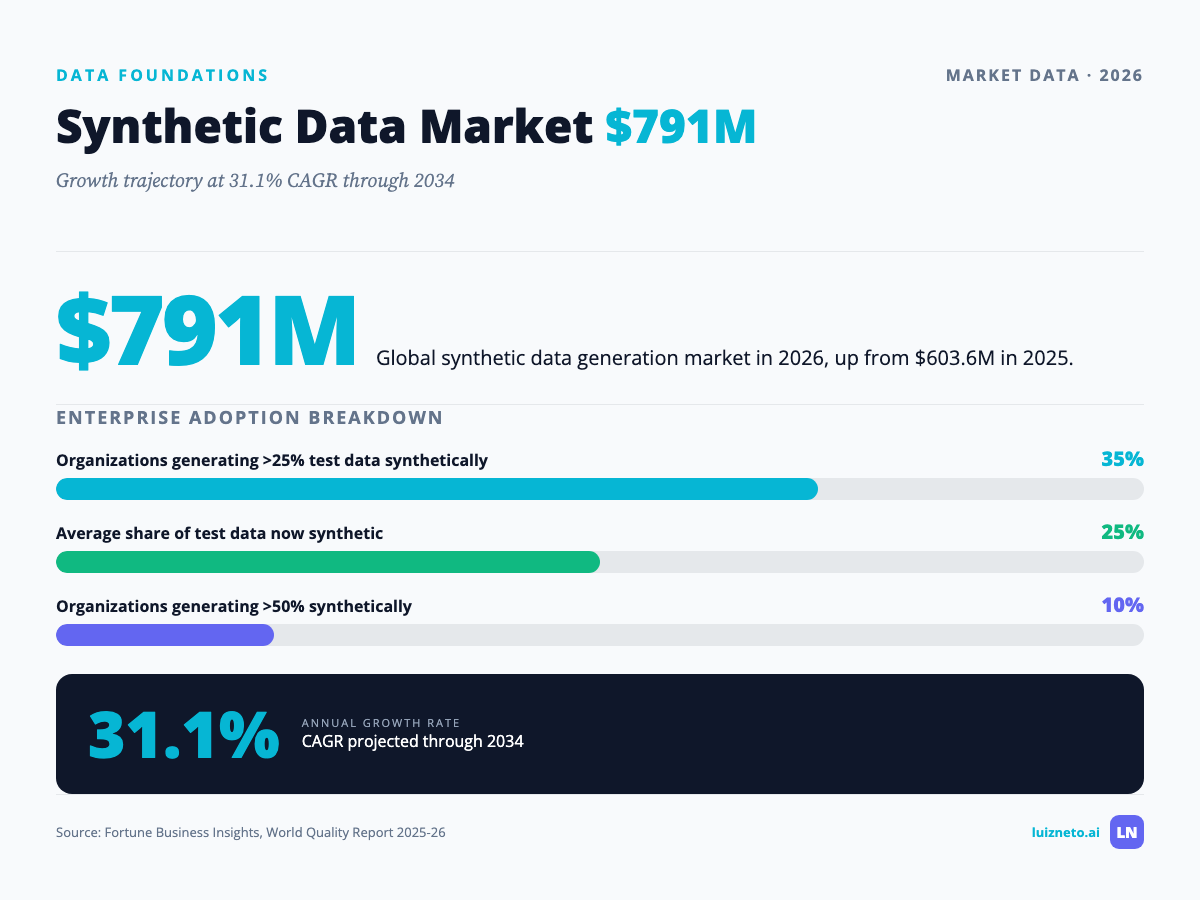
The numbers behind the adoption are concrete. 35% of organizations now generate more than a quarter of their test data synthetically. But only 10% generate more than half (World Quality Report 2025-26). That difference between experimentation and full commitment is telling. Enterprises are willing to start. They are not yet willing to depend on it for the systems that actually run the business.
Think of it as a trust ceiling. The generation tools are fast, cheap, and increasingly capable. The confidence that the generated output is good enough for production training sits well below the adoption curve. You can add generation capacity without adding verification, and the budget math works until something downstream breaks.
A quarter of test data is already generated. The question is not whether your organization will use it. The question is whether you will know when it fails.
Consider two VPs of data looking at the same dashboard. Both are running generated datasets through their testing pipelines. VP A tracks generation volume: how many records, how fast, how cheaply. VP B tracks validation coverage: which statistical tests ran, what the fidelity scores were, whether the privacy resistance checks passed. VP A has impressive throughput numbers for the quarterly review. VP B has proof that the synthetic data actually works. When a model trained on synthetic inputs starts drifting in production, VP A discovers it 11 days later from a customer complaint. VP B catches it from the diversity gate before the model ships. The difference is not talent or budget. It is whether you measure what you generate.
The shift toward synthetic data mirrors a broader reshaping of how enterprises assemble their model portfolios. When the training data pipeline changes, the model strategy has to change with it.
Why Enterprises Adopted Synthetic Data
Three drivers explain why enterprises started generating it. All three are rational. None is about quality measurement.
The first is edge-case coverage. 51% of organizations cite it as their primary driver (World Quality Report 2025-26). Production data is messy, incomplete, and biased toward the center of the distribution. The rare fraud patterns, the unusual sensor readings, the corner conditions that break a model in production but never appear in a test set. Generation fills those tails. That is a real engineering benefit, and it is why testing teams adopted it first.
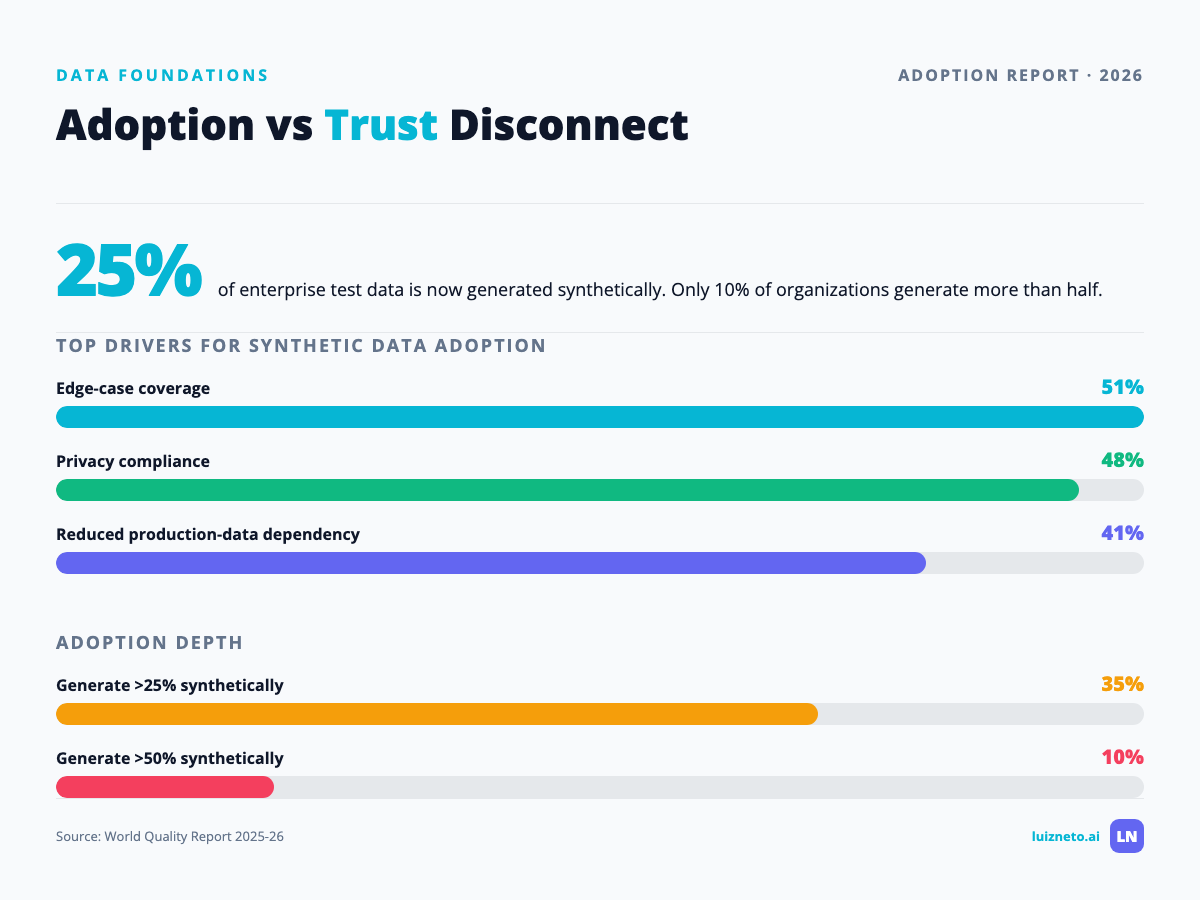
The second is privacy compliance. 48% of organizations name it as a top driver. Generated data, in theory, lets you train and test without exposing real personal records. Financial services, healthcare, and telecom were early adopters precisely because their production data carries regulatory weight that makes it expensive to use, slow to access, and risky to move between environments.
The third is reducing dependency on production data. 41% cite this. Accessing production datasets for testing means navigating access controls, data governance reviews, and compliance checkpoints. Generation sidesteps that pipeline entirely. A development team that previously waited three weeks for a sanitized extract can produce an equivalent in hours.
Generation methods follow a clear pattern. In biomedical applications, 74.6% of synthetic data is created through prompting, 20.3% through fine-tuning, and 5% through specialized models (Springer, 2026). The barrier to creating synthetic data has never been lower. A team with API access and a prompt template can generate millions of records in an afternoon.
Every one of those drivers solves a real problem. None of them includes a mechanism for confirming that the solution worked. Edge-case coverage sounds good until you realize the generated edge cases might not match the statistical properties of real edge cases. Privacy compliance sounds good until a membership inference test reveals the generative model memorized your most sensitive records. Reduced dependency on production data sounds good until the generated substitute introduces distributional biases that no one measured.
The adoption curve and the verification curve are diverging. Generation is easy and getting easier. Validation is hard, domain-specific, and underfunded. The organizations that get data readiness right are the ones that treat data quality as an engineering discipline, not a project milestone. Generated datasets do not get a pass on that standard.
The Validation Gap Nobody Named
Here is the number that should concern any enterprise scaling generation: only 4 of 17 academic surveys evaluating synthetic data provide reproducibility artifacts (ScienceDirect, 2026). That means 76% of the research validating synthetic data quality cannot be independently verified. You cannot rerun the tests. You cannot check the methodology against your own data. You take the paper's word for it, or you start from scratch.
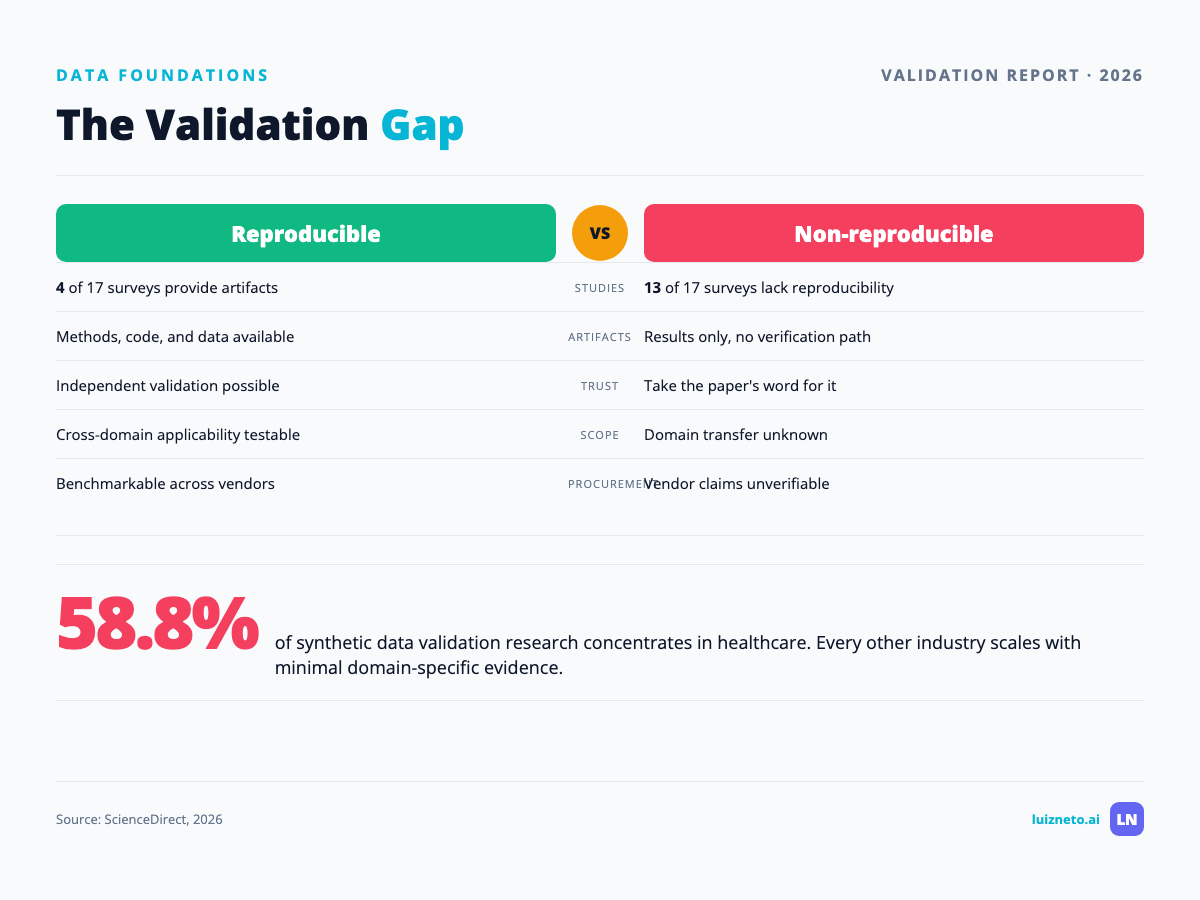
58.8% of that validation research concentrates in healthcare. One industry accounts for nearly six out of ten studies. Financial services, manufacturing, retail, energy, telecom, government. Those industries are scaling adoption with almost no domain-specific validation research to guide them. Healthcare has a head start because regulators forced the issue early: FDA submissions require documented data provenance, so researchers built the evaluation frameworks to satisfy them. The remaining industries are borrowing healthcare's methodology or building nothing at all.
The protocols are inconsistent even within the four reproducible studies. One measures statistical fidelity (does the synthetic distribution match the real one). Another measures privacy (can the synthetic records be linked back to individuals). A third measures downstream task performance (does a model trained on synthetic data perform as well as one trained on real data). No standard evaluation framework covers all three dimensions simultaneously.
For enterprises, this creates a practical procurement problem. You are shopping for a synthetic data platform, and you have no common benchmark to compare vendors against. Vendor A claims 99% fidelity. Vendor B claims 98% privacy preservation. Vendor C claims parity with real-data training performance. None of those numbers measures the same thing. None uses the same methodology. And because 76% of the underlying research is non-reproducible, you cannot verify any of them independently. You are choosing based on marketing materials, not on comparable evaluations. That is a procurement process, not a quality process.
Some research shows synthetic data achieving 90% satisfaction and reliability ratings, sometimes beating traditional online panels (Greenbook, 2026). That sounds reassuring until you look at what it measures. Satisfaction is a survey response. Reliability is self-reported. Neither is a statistical fidelity test. A user survey telling you the data "looks right" is not the same as a distributional comparison proving it is right. The difference matters when the synthetic data is training a model that will make financial, medical, or operational decisions.
This kind of structural problem compounds silently. Every quarter of scaling without standardized measurement is a quarter of accumulating risk that no one can quantify, because no one agreed on how to quantify it in the first place. Transparency in AI starts with reproducible evaluation. Without it, you are trusting a claim, not verifying a fact.
Model Collapse Is a Production Risk
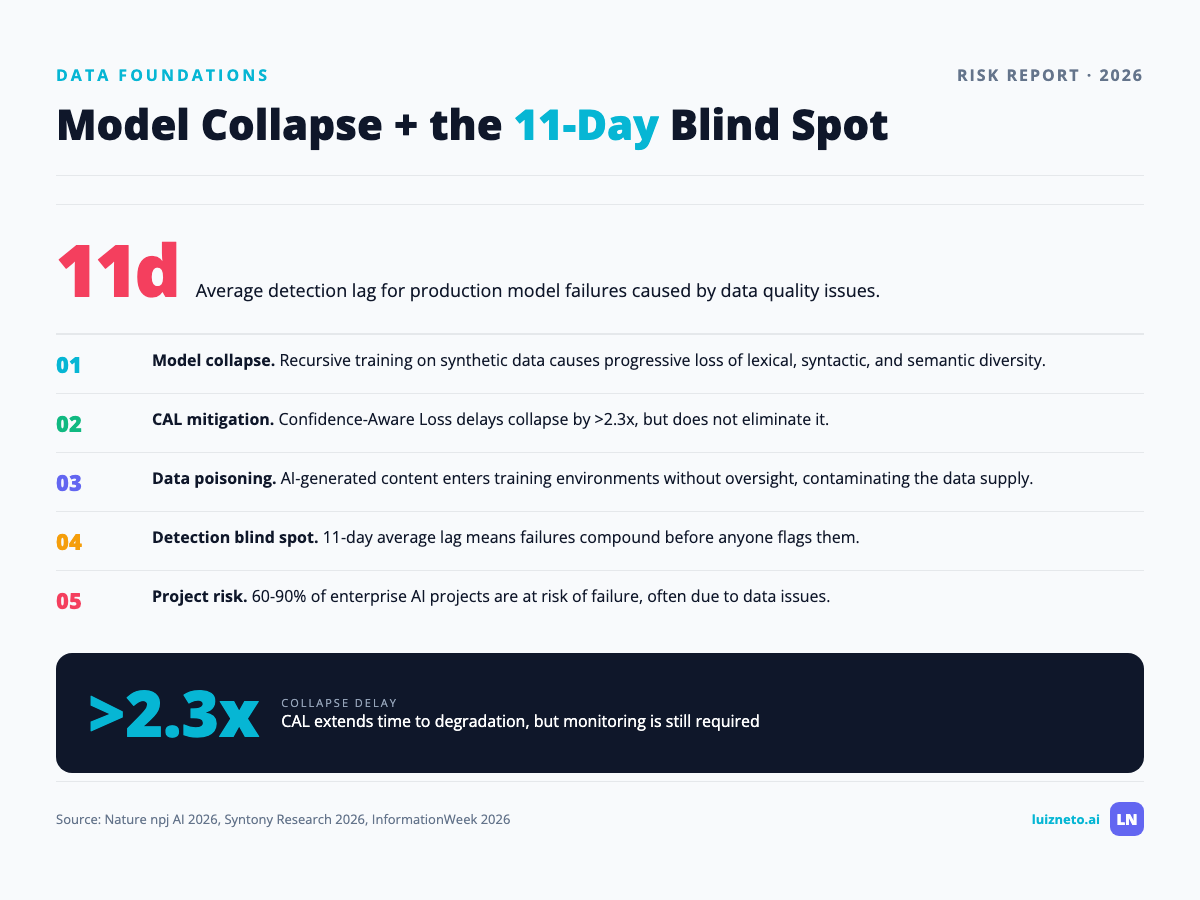
Train a model on generated output from another model. Then train the next generation on that output. Repeat. What happens is model collapse: a progressive loss of lexical, syntactic, and semantic diversity across generations (Nature npj AI, July 2026). This is not a theoretical scenario discussed in workshops. It is a measured degradation pattern with published evidence and a documented timeline.
The mechanism works like this. Each generation of recursive training narrows the output distribution. Rare tokens disappear first, because the model saw them fewer times and reproduces them with lower probability. Then unusual sentence structures thin out. Then entire categories of meaning vanish from the output. The distribution contracts toward the center, and the model becomes more confident as it becomes less accurate. It produces fluent, coherent text that covers less and less of the actual world.
The Nature paper introduces Confidence-Aware Loss (CAL), a training modification that delays model collapse by more than 2.3 times. CAL works by weighting the loss function based on the model's own confidence scores. Instead of treating every prediction equally, it pays more attention to uncertain predictions, the ones where the model is guessing rather than reinforcing what it already knows. That preserves more of the tail distribution and slows the narrowing process.
The honest assessment: CAL is a meaningful mitigation, not a cure. It delays collapse. It does not prevent it. The 2.3x factor means that if unmitigated collapse would degrade quality noticeably after 5 generations of recursive training, CAL pushes that to roughly 12 generations. That buys time. It does not buy immunity.
Any pipeline that feeds generated output back into training, whether intentionally as a data augmentation strategy or accidentally through contamination, needs a monitoring layer that watches for distribution narrowing over time. The monitoring should track token diversity, semantic coverage, and tail distribution weight across each generation. If you are not measuring diversity across generations, you will not see the collapse until the downstream model starts failing on the exact edge cases you generated the synthetic data to cover.
The pattern is insidious because it looks like improvement at first. Early generations of synthetic data train models that perform well on standard benchmarks, which are biased toward common cases. The performance drop shows up on unusual inputs first. By the time the degradation is visible on aggregate metrics, the distribution has already narrowed significantly.
The adjacent risk is inadvertent data poisoning. AI-generated content, including synthetic emails, code, and documents, enters training environments without proper oversight (InformationWeek, 2026). The data you generate intentionally is tracked. The generated content that leaks into your pipelines from third-party sources, public web scrapes, or internal tools that quietly adopted LLM generation is the part nobody tags or monitors. Both feed the same training set. Only one is governed.
Model portfolio decisions depend on knowing what went into the training data. When the training data includes generated output from prior models, your model portfolio strategy needs to account for that lineage.
The 11-Day Blind Spot
When a production model fails because of data quality issues, how long does it take your organization to notice? The average is 11 days (Syntony Research, 2026).
Eleven days. In financial services, that is 11 days of mispriced risk. In healthcare, 11 days of suboptimal clinical decision support. In supply chain, 11 days of inventory misallocation cascading through distribution networks. And that 11-day average means roughly half of incidents take longer.
The detection lag exists because typical AI monitoring systems watch the model's output metrics, not the input data quality. They flag when predictions drift from expected distributions. They do not flag when the training data feeding those predictions has quietly degraded. For synthetic data, the problem is worse. The synthetic pipeline is often treated as a preprocessing step, upstream of the monitoring perimeter. It generates data, the data enters the training set, and nobody checks the generation quality again until something breaks visibly downstream.
| Dimension | Market growth (supply) | Quality infrastructure (verification) |
|---|---|---|
| Market size 2026 | $791M, 31.1% CAGR | 4/17 studies reproducible |
| Enterprise adoption | 25% of test data synthetic | 58.8% validation in one industry |
| Generation methods | 74.6% prompting, 20.3% fine-tuning | No standard cross-domain framework |
| Failure detection | Production models deployed continuously | 11-day average detection lag |
| Risk exposure | 60-90% of AI projects at risk | Model collapse measured, mitigation partial |
| Source: Fortune Business Insights, World Quality Report 2025-26, Syntony Research 2026, ScienceDirect 2026 | luizneto.ai | ||
The broader picture reinforces the pattern. 60 to 90% of enterprise AI projects are at risk of failure, driven by data and governance issues rather than core modeling problems (TechRadar, 2026). The model is rarely what breaks. The data feeding the model is what breaks, and the monitoring that should catch data degradation is what fails to trigger in time.
Generated datasets do not fix this problem. They extend it into a domain with even less established monitoring. If your infrastructure cannot detect degradation in production data within 11 days, it almost certainly cannot detect degradation in generated data either. Your generation pipeline needs its own monitoring layer, independent of the production data monitors, calibrated to the specific failure modes that generation introduces: distribution drift, memorization leakage, and diversity loss.
Get the synthetic data validation checklist. Three gates, nine checks, one page. The same framework this article builds, designed for your Monday procurement review.
When agent-based systems depend on data pipelines that include synthetic inputs, the production gap compounds with every unverified data source in the chain.
What GDPR and the EU AI Act Require
A common assumption: synthetic data is not personal data, so GDPR does not apply. That assumption is wrong, and it is expensive when it breaks.
Synthetic data that can be re-identified or reverse-engineered back to real individuals falls under GDPR's definition of personal data. The test is not whether the data was generated artificially. The test is whether it can be linked back to a natural person using any reasonably available means. If the generative model memorized patterns specific enough to identify someone, the output is personal data regardless of how it was created. A synthetic health record that reproduces a rare combination of diagnosis, zip code, and age is not anonymous. It is identifiable, and it is in scope.
| Regulation | Requirement for synthetic data | Consequence of non-compliance |
|---|---|---|
| GDPR | Re-identifiable synthetic records are personal data. Privacy impact assessment required. | Fines up to 4% of global annual turnover |
| EU AI Act (Art. 10) | Training data for high-risk AI must be documented with transparency and audit trails. | Prohibited practices: up to 7% of turnover. High-risk non-compliance: up to 3%. |
| EU AI Act (Aug 2026) | Synthetic data used in high-risk systems must meet the same data quality standards as real data. | Market surveillance enforcement begins |
| Source: GDPR framework, EU AI Act (Regulation 2024/1689) | luizneto.ai | ||
The EU AI Act adds a second, more specific layer. For high-risk AI systems, Article 10 requires transparency and audit trails for all training data, including synthetic data. You need to document what was generated, how it was generated, from what source model, with what parameters, and how quality was validated. "We used a synthetic data platform" is not a compliance answer. The regulator will ask which tests you ran, and you need to point to the results.
The practical implication: your generation pipeline needs the same governance envelope as your production data pipeline. Data lineage tracking from source model to output. Quality documentation for every batch. Privacy impact assessments before the data enters a training pipeline. Audit trails that a regulator can follow from the finished model back to the generation parameters.
Most enterprises have not built this envelope for synthetic data yet. The pipeline was introduced as a testing convenience, and the governance layer never caught up to its expanded role. That worked when synthetic data was 5% of the test set. At 25% and growing, the governance deficit is a compliance liability. The August 2026 enforcement deadline for the EU AI Act has not moved. The compliance clock is running on your synthetic data pipeline too.
The Three Validation Gates
Gartner recommends enterprises move toward integrated, domain-specific synthetic data platforms that bundle generation, validation, and governance into a single offering (Gartner, 2025). That direction is right. But the platform is just the vehicle. What matters is what the platform measures, and right now, most platforms measure generation volume, not output quality.
Synthetic data is not a shortcut around data quality. It is an engineering discipline that requires the same rigor as the production data it replaces. Measure fidelity, prove privacy, test diversity. Skip one and you are scaling a guess.
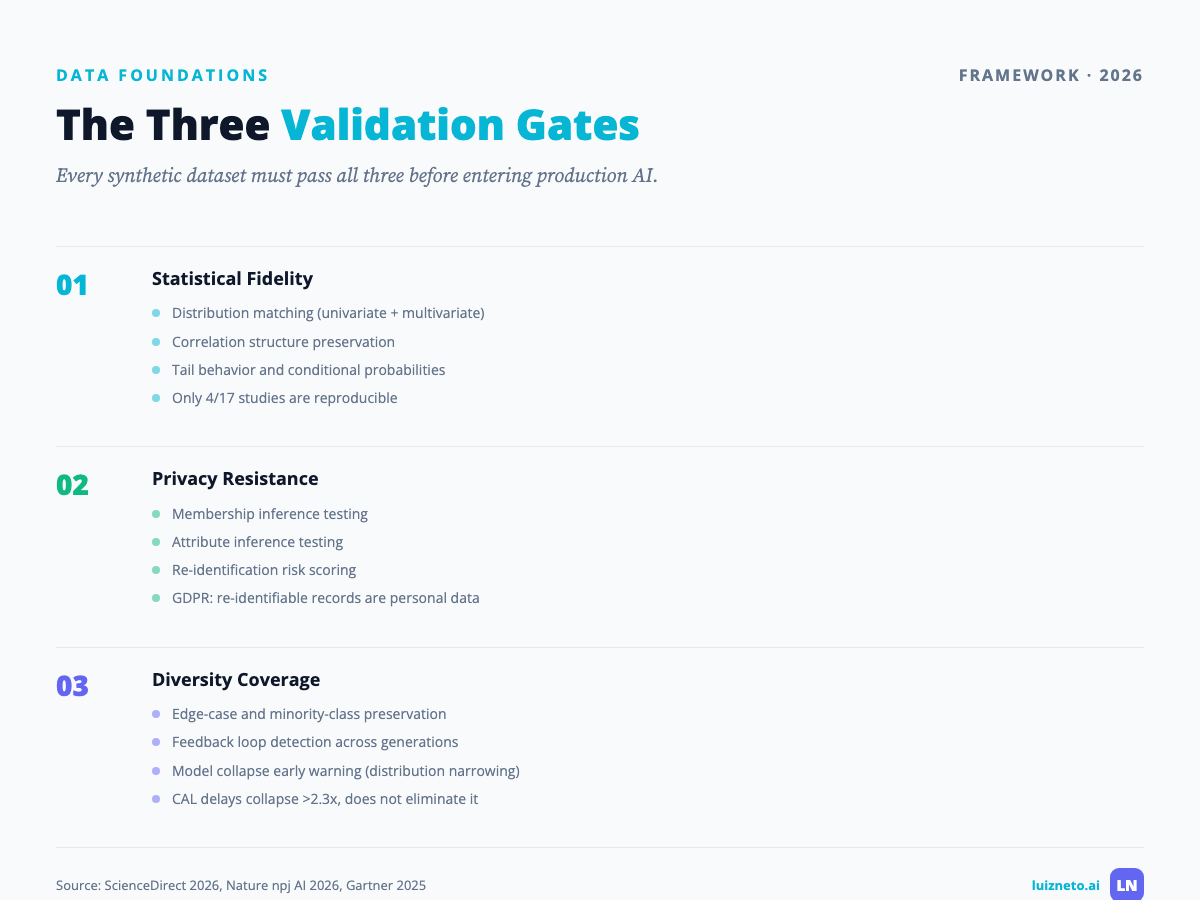
Every generated dataset entering a production pipeline should pass through three gates before it ships. These gates are independent. Passing one does not imply passing the others.
Gate 1. Statistical Fidelity
Does the generated data match the statistical properties of the real data it replaces? Distribution shapes, correlation structures, conditional probabilities, and tail behavior all need to match within documented tolerances. This is not a single number. Fidelity is multidimensional.
A dataset can match marginal distributions perfectly while destroying the joint distribution. Two columns might each look right on their own, but the relationship between them, the correlation a downstream model depends on, is gone. The test suite needs to cover univariate, bivariate, and multivariate statistical comparisons. When only 4 of 17 studies are reproducible, fidelity testing is the first and most urgent verification to get right.
What a fidelity test suite looks like in practice: Kolmogorov-Smirnov tests on each column, pairwise correlation matrix comparison, and at least one multivariate test (such as maximum mean discrepancy) that checks the joint distribution. Document the tolerances. Document the results. Store them next to the dataset. If your vendor cannot show you these results for your domain, that tells you something about what they are actually validating.
Gate 2. Privacy Resistance
Can any record in the generated dataset be linked back to a real individual? The privacy gate requires three tests: membership inference testing (can an attacker determine whether a specific real record was in the training set), attribute inference testing (can an attacker recover sensitive attributes from the synthetic output), and re-identification risk scoring against known population data.
If the generative model memorized outliers, which it will for any individual with a rare combination of attributes, the output leaks them. The privacy gate catches that before it becomes a GDPR incident. This is not a theoretical attack. Membership inference attacks on generative models are well documented in the research literature and automatable with open-source toolkits. The attack surface is straightforward: feed candidate records into a classifier and determine whether each one was likely part of the training set. For any organization handling medical records, financial transactions, or employee data, the answer matters for regulatory compliance as much as for security. The question is not whether an attacker could run a membership inference test on your synthetic data. The question is whether you ran one first, and whether you documented the result alongside the dataset before it entered production.
Gate 3. Diversity Coverage
Does the generated dataset preserve the diversity of the original? Edge cases, minority classes, rare events. These are precisely the patterns that model collapse eliminates first. A dataset that passes fidelity and privacy checks can still fail the diversity gate if the generative model smoothed over the tails, which generative models reliably do. Generative models are optimized to reproduce the center of the distribution well. That is exactly the opposite of what you need for edge-case coverage, the reason 51% of organizations cited for adopting synthetic data in the first place.
Diversity testing is also where you catch the feedback loop. If this dataset will feed a model whose output will eventually generate the next dataset, the diversity gate is your early warning system for distribution narrowing. Run it at every generation, not just the first. The first generation often looks fine. The third or fourth is where the tails disappear, and by then your model has already been retrained on the narrowed data two or three times.
A practical diversity check compares the number of distinct clusters (or modes) in the synthetic output against the real data, using a clustering algorithm on the feature space. If real data has 12 distinct customer segments and the generated output collapses them to 8, that is a measurable diversity failure before it becomes a model performance failure. Track this metric per generation. Plot it. When the curve bends, stop and investigate.
I used to believe a strong model was most of the battle. Production taught me otherwise. The model is as good as the data in, and "data in" now includes generated sources that nobody audits with the same rigor applied to production extracts. Three gates. Fidelity, privacy, diversity. The validation stack is only as strong as its weakest gate. The 4-of-17 reproducibility figure tells you the field has not standardized these tests yet. The enterprises that measure at all usually stop at fidelity and skip privacy and diversity.
These three gates extend the readiness stack that separates enterprises that can scale AI from everyone else. Data readiness is the foundation. Synthetic data validation is the next layer up.
Frequently Asked Questions
What is synthetic data and how is it used in enterprises?
Synthetic data is AI-generated data designed to mimic real datasets while avoiding direct use of sensitive records. Enterprises use it for testing (25% of test data is now synthetic), model training, and privacy-compliant development. Primary applications include edge-case generation, compliance testing, and reducing dependency on production data access.
How do you validate synthetic data quality?
Validate through three gates: statistical fidelity (distribution matching against real data), privacy resistance (membership and attribute inference testing), and diversity coverage (edge-case and minority-class preservation). Only 4 of 17 academic surveys provide reproducible validation artifacts, making in-house testing critical.
What are the risks of using synthetic data for AI training?
Three primary risks: model collapse from recursive training on synthetic outputs (measured degradation, delayed 2.3x by CAL but not eliminated), inadvertent data poisoning from untracked synthetic content entering pipelines, and quality drift that takes an average of 11 days to detect in production environments.
Does synthetic data comply with GDPR?
Only if it cannot be re-identified. Synthetic records that can be linked back to real individuals are personal data under GDPR. The EU AI Act adds audit trail requirements for synthetic data used in high-risk AI systems. Privacy resistance testing is mandatory, not optional.
What is model collapse and how does synthetic data cause it?
Model collapse occurs when models trained recursively on synthetic data lose lexical, syntactic, and semantic diversity across generations. Each cycle narrows the output distribution. Confidence-Aware Loss (CAL) delays collapse by over 2.3x but does not eliminate it. Continuous diversity monitoring is required.
How much is the synthetic data market worth in 2026?
The global synthetic data generation market is valued at approximately $791 million in 2026, up from $604 million in 2025, with a 31.1% compound annual growth rate projected through 2034, according to Fortune Business Insights.
What is hyper-synthetic data?
Gartner's term for integrated, domain-specific synthetic data platforms that combine generation, validation, and governance in a single offering. The recommendation reflects the market's shift from standalone generation tools toward platforms that bundle quality assurance and compliance into the generation workflow.
What to Do Monday
The synthetic data market will pass $1 billion. That is arithmetic, not speculation. The question every enterprise scaling synthetic data needs to answer is whether the quality infrastructure will keep pace with the generation capacity, or keep trailing behind it by another order of magnitude. Right now, the market incentive structure rewards generation speed. Vendors compete on volume, latency, and cost per record. Nobody puts "reproducible fidelity score" on the feature comparison slide. That will change when the first regulatory audit lands on a synthetic data pipeline, or when a production failure traces back to unvalidated synthetic training data. The enterprises that build the validation stack now will be better positioned than those scrambling to retrofit one later.
Before your next procurement decision, audit your synthetic data pipeline against the three validation gates. Fidelity: can you show a distributional comparison between synthetic and real data? Privacy: have you run a membership inference test? Diversity: are you tracking coverage of edge cases and minority classes across generations?
If you cannot point to a reproducible test for each gate, you are scaling output without proof. That is the $791M quality problem, and it does not fix itself.
For the frameworks and governance questions shaping enterprise AI every week, subscribe to the weekly brief.