89% of AI Agent Pilots Never Reach Production
New data from Deloitte, HCLTech, and Nasuni shows the AI agent production gap widened to 89%. Enterprises are now actively rolling back deployed agents.
89% of AI Agent Pilots Never Reach Production
Three weeks ago, I published the AI agent production numbers: a 56.6% success rate across 6,259 deployed agents. The reaction was strong. The data since then is stronger.
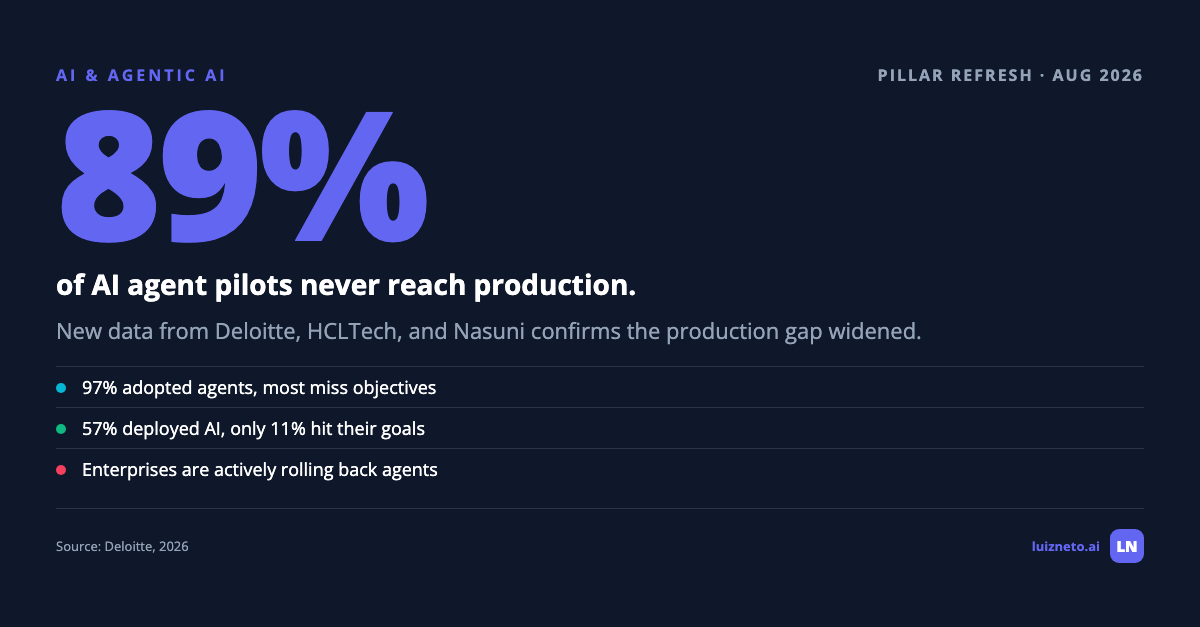
Deloitte's 2026 Tech Trends report puts the AI agent production failure rate at 89%. Only 11% of enterprise agent pilots cross the line into production. That is not a scaling problem. That is a structural one.
New reports from HCLTech, Nasuni, and Kyndryl confirm the pattern and add a twist: enterprises that did deploy are now pulling agents back. The failure mode shifted from "cannot scale" to "scaled and now retreating." This piece tracks what changed, where the data moved, and what the rollback pattern means for your next AI agent production decision.
Subscribe to the weekly brief for the running numbers on enterprise AI agent production, governance, and reliability.
Key Takeaways
- 89% of AI agent pilots fail before reaching production (Deloitte 2026).
- 97% of enterprises adopted agents, but most miss their objectives.
- 57% deployed AI broadly, yet only 11% achieved their top goals.
- Advanced organizations are rolling back agents, not just stalling.
- 83% of enterprises need infrastructure overhauls for agentic AI.
Contents
- Where AI Agent Pilots Stood in Mid-July
- Three New Reports Say It Is Worse
- 57% Deployed. 11% Hit Their Goals.
- The Rollback Pattern
- The Infrastructure Reality Check
- What Changed in Three Weeks
- What the 11% Did Differently
- FAQ
Where AI Agent Pilots Stood in Mid-July
The baseline was not good. AI agent production data collected by Foundra across 6,259 deployed agents showed a 56.6% success rate over 4.5 million test runs. That is a coin flip.
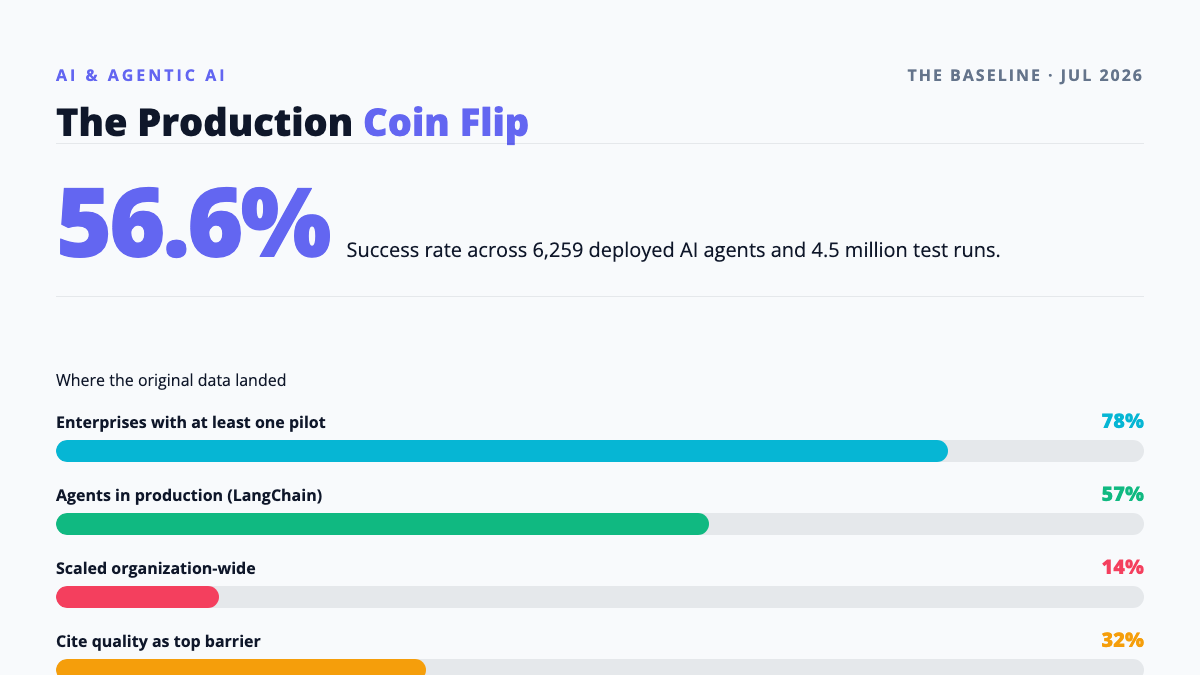
Teradata's survey added context: 78% of enterprises had at least one agent pilot running, but only 14% had scaled an agent to organization-wide use. The distance between "we have a pilot" and "it works at scale" was already enormous.
LangChain's State of Agent Engineering showed 32% of teams citing quality and reliability as their top barrier to AI agent production deployment. Not cost. Not talent. The agents themselves were simply not reliable enough.
The tau-bench research from Sierra AI quantified what "unreliable" looks like in practice: agent performance drops from roughly 60% success on a single run to about 25% when the agent must succeed 8 consecutive times on the same task. That pass-to-the-power-of-k reliability curve is what separates a working demo from a working deployment.
That was mid-July. Then the new data arrived.
Three New Reports Say It Is Worse
Deloitte's 2026 Tech Trends puts the pilot-to-production failure rate at 89%. That is worse than the Teradata data suggested three weeks ago. It means nearly nine out of ten agent pilots die before they produce value.
HCLTech warns that 43% of enterprise AI initiatives may fail entirely, and leaders face a shrinking window to course-correct. The assessment applies to programs running right now, with shrinking time to fix.
Nasuni's research adds the starkest contrast: 97% of enterprises are adopting AI agents. Most of those projects fail to meet their stated objectives. Nearly universal adoption. Nearly universal underperformance.
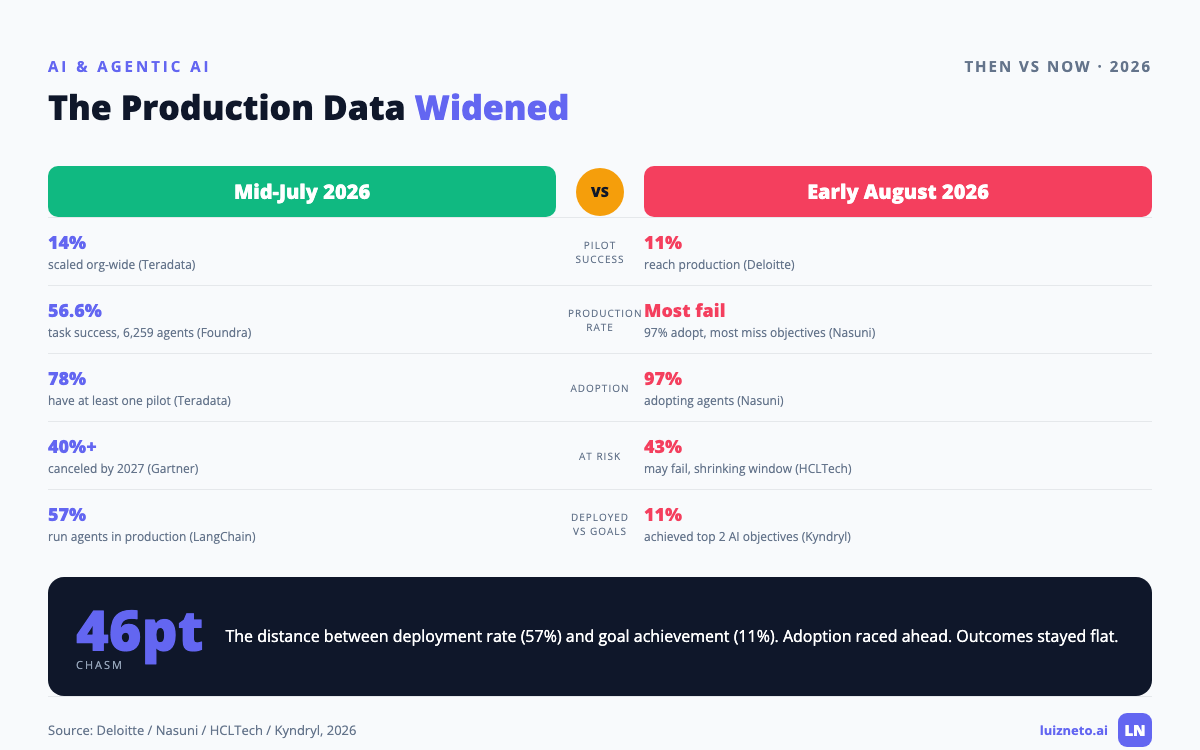
| Metric | Mid-July 2026 | Early August 2026 | Source |
|---|---|---|---|
| Pilot-to-production success | 14% scaled org-wide | 11% reach production | Teradata / Deloitte |
| Production success rate | 56.6% across 6,259 agents | Most fail objectives (Nasuni) | Foundra / Nasuni |
| Adoption rate | 78% have at least one pilot | 97% adopting agents | Teradata / Nasuni |
| At-risk initiatives | 40%+ canceled by 2027 (Gartner) | 43% may fail (HCLTech) | Gartner / HCLTech |
The direction is consistent across all sources. Adoption climbed. Success rates did not follow. The original AI agent production analysis underestimated the problem.
For the full ROI picture, see the enterprise AI ROI data we published last week. The financial underperformance tracks the same pattern.
57% Deployed. 11% Hit Their Goals.
Kyndryl's 2026 People Readiness Report contains the most telling number in this entire refresh. 57% of enterprises have broadly deployed AI. Only 11% have achieved their top two AI objectives.
That is a 46-point deployment-to-outcome chasm. More than four out of five organizations that deployed are running systems that do not deliver what they were built to deliver.
This is the number that separates a scaling problem from a design problem. If the issue were purely operational (infrastructure, integration, monitoring), you would expect a gradual improvement curve as organizations mature. Instead, the data shows deployment racing ahead while outcomes stay flat.
The implication is uncomfortable. Many enterprises deployed agents because the technology was available and the board expected it. The business case followed the deployment, not the other way around. When the objective was "deploy AI" rather than "solve this specific workflow bottleneck," the agent shipped without a clear success criterion.
That 11% likely represents the organizations that started with a measurable business problem and built the agent around it. The other 46 points represent the organizations that started with the technology.
Consider two enterprise teams. Team A runs a claims-processing agent that was built to reduce resolution time from 48 hours to 4, with a measurable baseline and a defined error tolerance. Team B runs a "general-purpose AI assistant" that was deployed because the board asked for an AI initiative. Team A knows within a week whether the agent is working. Team B discovers six months later that "working" was never defined. Both show up in the 57% deployment figure. Only Team A has a path to the 11%.
The lesson is structural. AI agent pilots that ship without a quantified success criterion cannot, by definition, succeed. They can only run. And running without a destination is exactly how you end up deployed but directionless, adding to the 46-point chasm.
The Rollback Pattern
Here is where the AI agent production story changes qualitatively. The original analysis described a scaling failure. The new data describes something different: an active retreat.
ITPro reports that enterprises are quietly reverting agent deployments. Not pausing. Not "evaluating." Reverting. Customer-facing AI agents are being pulled out of production after disappointing results or, worse, customer complaints.
The most advanced organizations are not failing less. They are seeing failures sooner and choosing to roll back rather than push through.
That sentence is the update to the original analysis. Three weeks ago, the pattern was: build, demo, try to scale, fail. Now the pattern has a new phase: build, demo, scale, discover, roll back.
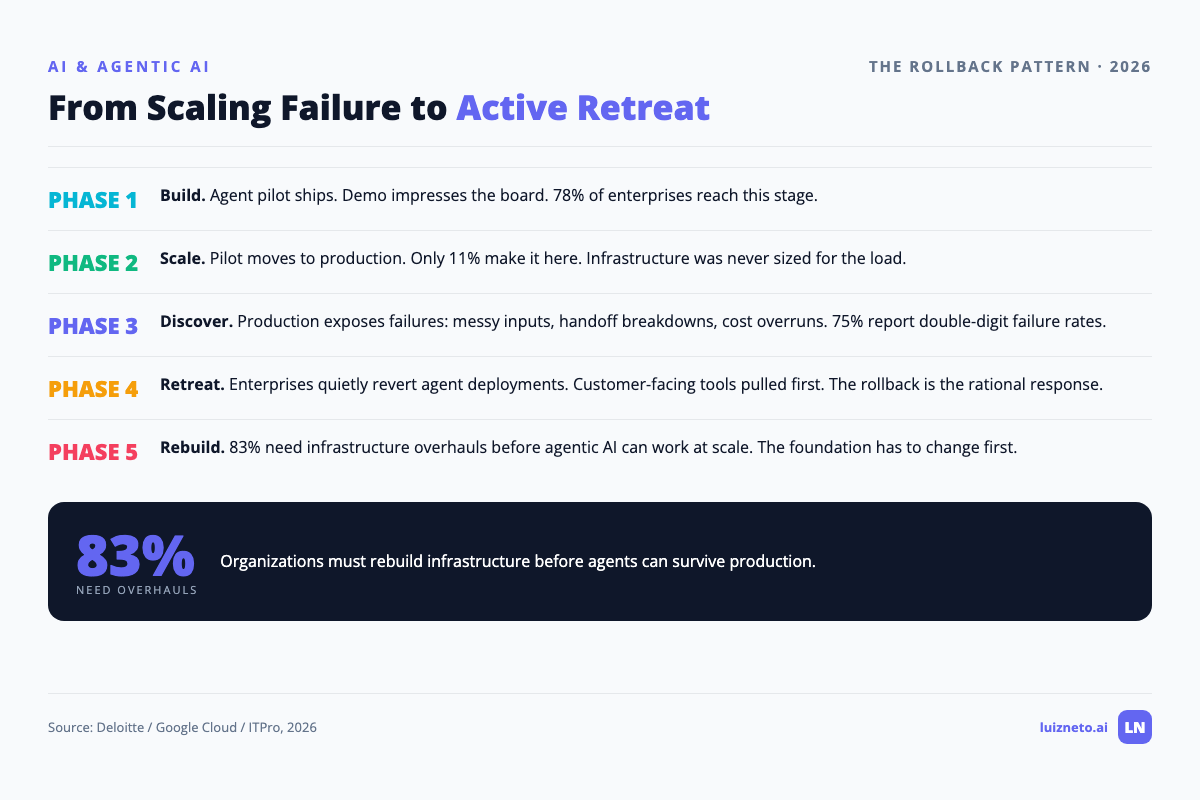
TechRadar's coverage of the rollback trend emphasizes that this is concentrated in customer-facing deployments. Chatbots, support agents, and automated recommendation systems are the first to be pulled. These are high-visibility, high-risk surfaces where a failing agent creates immediate customer impact. Internal-facing agents (document processing, code review, data extraction) survive longer because their failure modes are less visible.
The pattern is consistent with how cloud computing matured a decade ago. The first generation of cloud migrations also saw rollbacks, particularly when organizations moved workloads that were not designed for distributed infrastructure. The fix then was not abandoning the cloud. It was rebuilding the workloads for the new architecture. The same logic applies to AI agent pilots.
The rollback is also expensive, and the cost is not just financial. Every agent pulled from production carries sunk costs: the development time, the integration work, the data pipeline that was built to feed it, and the organizational credibility spent to launch it. But the cost of leaving a failing agent in production is higher. A customer-facing agent that gives wrong answers at scale damages the brand faster than no agent at all. The organizations rolling back are making the rational call. The question is whether they will rebuild or walk away.
ITPro's broader analysis confirms that IT leaders remain bullish on AI agent pilots even as their current deployments fail. The ambition has not faded. But the path from ambition to production now includes a phase that most roadmaps did not plan for: the rebuild after the rollback.
The Infrastructure Reality Check
A Google Cloud report adds the infrastructure dimension to the AI agent production picture: 83% of organizations must overhaul their infrastructure to support agentic AI at scale. The agents themselves may work. The systems they run on do not.
This maps directly to the reliability patterns we covered in the enterprise RAG reliability analysis. Infrastructure readiness is the thread connecting both failures.
The infrastructure problem behind the AI agent pilots failing in production has three layers. First, compute: agentic workloads consume tokens unpredictably. A pilot serving 50 users consumes linearly. A production agent serving 5,000 users consumes in bursts, and each burst carries a cost the pilot budget never modeled. Second, data: agents need access to enterprise data stores that were designed for human-query patterns, not machine-query-at-scale patterns. Third, observability: the tools that monitor traditional software do not capture agent decision chains, so failures go undetected until their downstream effects surface.
Running an agent pilot right now? Audit the infrastructure layer before you scale. The rollback pattern starts with agents that passed QA but broke in a production environment the infrastructure was not designed for.
What Changed in Three Weeks
Three shifts moved the AI agent production picture between mid-July and early August 2026.
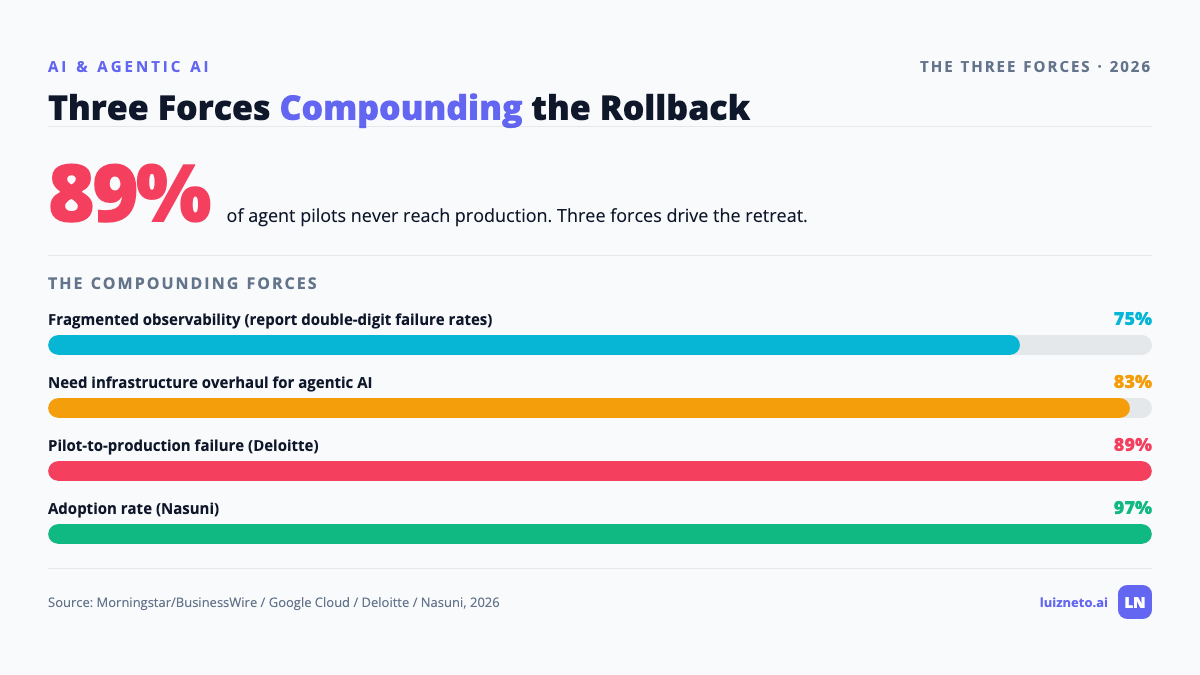
1. Failure became visible. A study reported via Morningstar/BusinessWire found that 75% of enterprises report double-digit AI failure rates. The cause: fragmented observability. Organizations could not see where agents were failing until the failures stacked up. The visibility lag means the numbers today reflect problems that started weeks or months earlier.
2. Cost reality arrived. ITPro's reporting on "tokenmaxxing" shows AI cost management repeating the same mistakes as early cloud adoption. Enterprises face large, unexpected AI bills. The cost of running agents at scale was underestimated during the pilot phase, when token consumption was low and the business case assumed linear cost scaling. The pattern is identical to early cloud overruns: a pilot-grade cost model meets production-grade volume, and the budget breaks.
3. The infrastructure question landed. That Google Cloud finding of 83% needing infrastructure overhauls is not a future problem. It is the current blocker. Agents built on demo-grade infrastructure hit production-grade load and break. A better model will not solve this. The foundation has to change first.
These three forces compound, and they explain why so many AI agent pilots fail in production. Poor observability hides failures. Hidden failures accumulate cost. Accumulated cost hits an infrastructure that was never sized for it. The rollback is the rational response.
For the governance questions boards should be asking right now, see the five board-level AI agent governance questions.
What the 11% Did Differently
The 11% of enterprises that achieved their top AI objectives share three observable patterns.
They started with the problem, not the technology. The successful deployments began with a specific, measurable business bottleneck. Not "deploy an AI agent" but "reduce claim processing time from 48 hours to 4." The success criterion existed before the first line of agent code. When the agent did not meet the criterion, they had a clear signal to fix it rather than declare victory and move on.
They invested in infrastructure before scaling. The 83% who need overhauls are paying the cost of scaling first and building second. The 11% spent the first quarter of their project on the data layer, the compute model, and the observability stack. This felt slow at the time. It meant they had a foundation that could absorb production load without breaking.
They built observability into the agent from day one. Not as an afterthought, not as a separate monitoring project. The agent's decision chain was instrumented from the first deployment, so when failures occurred (and they did), the team could trace the failure to its root cause within hours. The 75% with fragmented observability discovered their failures weeks later, when the damage had compounded and the cost of repair was multiples of what early detection would have required.
There is a downside to this approach, and naming it matters. Building observability and infrastructure first is slower. The teams that do it will ship their AI agent pilots to production later than the teams that skip it. In quarters where the board is measuring "did we deploy AI," the slower path looks like underperformance. But the data is clear: the fast path leads to the 89%. The slow path leads to the 11%.
The Capgemini RAISE report on scaling AI reinforces this. Organizations that invested in foundational readiness before scaling reported measurably better outcomes. The investment was not in models. It was in everything the models need to run reliably: data quality, governance, monitoring, and a cost model that survives contact with production volume. This is the unsexy work that separates the 11% from the 89%.
Frequently Asked Questions
Why do AI agent pilots fail in production?
The primary failure modes are reliability at scale (agents that pass QA but break on messy real-world inputs), infrastructure that cannot support agentic workloads, and fragmented observability that hides failures until they compound. Deloitte's 2026 data shows 89% of pilots never cross the production threshold.
What percentage of AI agents succeed in enterprise production?
AI agent production success rates vary by measurement. Foundra's analysis of 6,259 agents found 56.6% task success. Kyndryl reports only 11% of deploying enterprises achieved their primary objectives.
How do you scale AI agents from pilot to production?
Start with a measurable business problem, not the technology. Invest in production-grade infrastructure before scaling. Google Cloud data shows 83% of organizations need infrastructure overhauls. Build observability into the agent from day one, not after deployment.
What is the AI agent rollback trend?
Enterprises that deployed agents to production are actively reverting them after poor results or customer complaints. ITPro reports a pattern of quiet rollbacks, particularly in customer-facing use cases. This shifts the failure mode from "cannot scale" to "scaled and now retreating."
How much does a failed AI agent pilot cost?
Direct pilot costs vary widely. The hidden cost is larger: ITPro documents "tokenmaxxing", where token consumption at production scale far exceeds pilot projections. Add infrastructure rebuild costs for the 83% that need overhauls, and the total investment dwarfs the model budget.
What to Do With This Data
The rollback wave is a correction, not a collapse. The 11% of enterprises that hit their AI objectives share a pattern: they started with a defined business problem, invested in infrastructure before scaling, and built observability into the agent from the first deployment.
The 89% that failed share a different pattern: technology-first adoption, demo-grade infrastructure, and a business case written after the pilot shipped.
If you are running AI agent pilots today, here is what the data says you should do before your next scaling decision:
- Define the success criterion before you scale. A pilot without a quantified target cannot succeed. "Deploy AI" is not a success criterion. "Reduce claim processing from 48 hours to 4 with less than 2% error rate" is. The 11% started here.
- Audit the infrastructure layer. The 83% who need infrastructure overhauls will discover that fact either before production (when the fix is planned) or during production (when the fix is a fire drill). Check compute capacity, data pipeline throughput, and monitoring instrumentation. If any layer is demo-grade, it will break at production scale.
- Instrument observability from day one. The 75% with fragmented observability are the 75% who cannot explain why their agents fail. Decision-chain tracing, token consumption monitoring, and error classification are not optional. They are the difference between a fixable failure and a mysterious one.
- Model the cost at production volume. Tokenmaxxing kills budgets because the pilot cost model assumed linear scaling. Token consumption at scale is bursty and nonlinear. Build a cost model from actual production traffic patterns, not pilot averages.
- Plan for the rollback. If your agent fails in production, you need a graceful revert path. The enterprises rolling back customer-facing agents right now are doing it in a rush because they never planned for it. A rollback plan is not pessimism. It is engineering.
The question is not "will your AI agent pilots scale?" The question is "do you have the infrastructure, the observability, and the business case to survive production?" If not, the rollback wave will answer the question for you.
I will keep tracking these numbers. Subscribe to the weekly brief for the running data on enterprise AI agent production, governance, and reliability, or read the full original production analysis for the baseline.