The EU AI Act Deadline That Did Not Move to 2027
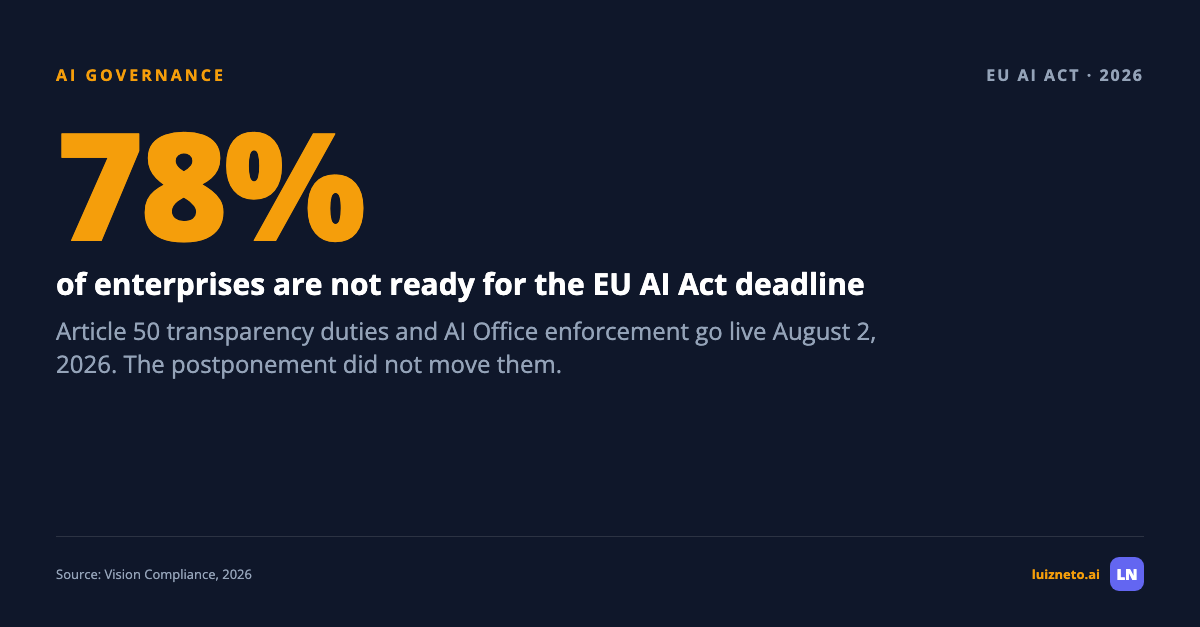
78% of enterprises took the postponement headlines as a stand-down order. But the EU AI Act deadline that matters, August 2, 2026, did not move: transparency duties become enforceable and the AI Office starts fining. Here is what fires and the 20-day response.
The EU AI Act Deadline That Did Not Move to 2027
78% of organizations across eight EU industries have taken no meaningful steps toward EU AI Act compliance (Vision Compliance, 2026). Most of them believe they have until December 2027, because that is what the postponement headlines said in June. They read the wrong line of the regulation.
The EU AI Act deadline that matters is August 2, 2026. It did not move. On that date, transparency obligations become enforceable and the European Commission's AI Office switches from guidance to fines.
In the next eight minutes you will know exactly which obligations reach your organization on August 2, what enforcement can now do about them, and the four moves that close the distance in the twenty days you have left.
Key takeaways
- The Digital Omnibus moved high-risk rules, not transparency rules.
- Article 50 disclosure duties become enforceable August 2, 2026.
- The AI Office can fine GPAI violations retroactively to 2025.
- 78% of enterprises have taken no meaningful compliance steps.
- A focused 20-day sprint covers the four exposed surfaces.
Contents
- The EU AI Act deadline that moved, and the one that did not
- What still fires on August 2, 2026
- Enforcement stops being theoretical
- The readiness numbers no one wants to own
- What non-compliance actually costs
- Person A and Person B on August 2
- The 20-day sprint
- Frequently asked questions
The EU AI Act deadline that moved, and the one that did not
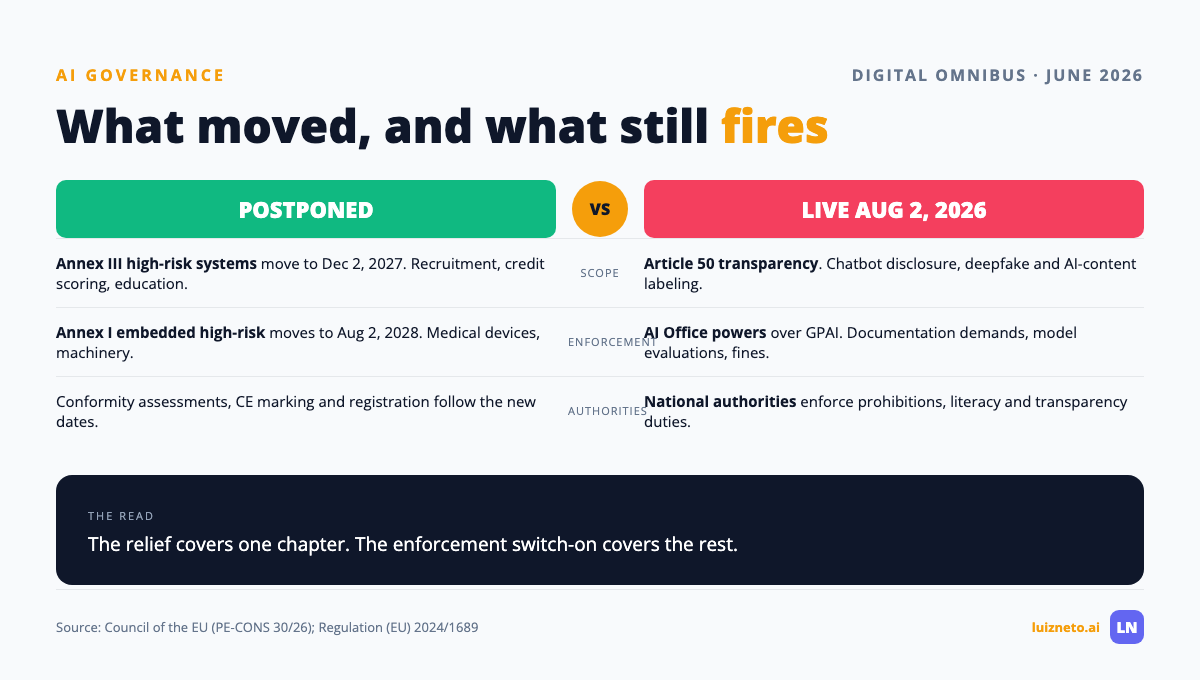
On June 29, 2026, the Council of the EU gave final approval to the Digital Omnibus package (Council of the EU, 2026). The European Parliament had endorsed it on June 16. The package moves the compliance dates for high-risk AI systems: stand-alone Annex III systems shift from August 2, 2026 to December 2, 2027, and high-risk AI embedded in regulated products moves to August 2, 2028.
That is real relief. Recruitment screening, credit scoring, education systems. The heavy conformity work for all of them just gained sixteen months.
Two details got lost in the celebration.
First, the omnibus is approved but not yet published in the Official Journal. Until publication, the original dates formally remain law. Treat the new dates as near-certain for planning. Do not treat them as binding yet.
Second, and far more expensive: the postponement covers one chapter of the regulation. Everything else scheduled for August 2, 2026 arrives on time. Transparency obligations. Enforcement powers. The penalty regime in full operation.
In my advisory work the pattern repeats on weaker signals than a Council press release. A postponement headline lands in a steering committee, budgets get redirected, and the compliance workstream quietly loses its staffing. That is the state of many EU AI programs right now, three weeks before enforcement begins.
The distinction that follows decides whether your organization is exposed. It also decides what you owe your board in the next planning cycle, which starts with knowing why transparency and explainability carry business weight beyond compliance.
What still fires on August 2, 2026
The omnibus changed when the high-risk rulebook arrives. It did not change what enforcement can do in August. Those are not the same relief.
Here is what becomes enforceable on August 2, 2026 under Article 50 of the AI Act (Regulation (EU) 2024/1689).
- AI interaction disclosure. If a person is talking to your chatbot or voice agent, they must be told they are talking to an AI, unless the context makes it obvious.
- Synthetic content labeling. AI-generated or AI-manipulated content, including deepfakes, must be disclosed as such.
- AI-generated text disclosure. Text published to inform the public on matters of public interest must be labeled as AI-generated, unless a human editor takes responsibility for it.
- Emotion recognition disclosure. People exposed to emotion recognition or biometric categorization systems must be informed those systems are running.
Read that list again as an inventory question. Customer service bots. Marketing content pipelines. HR screening tools with sentiment features. Sales enablement that drafts prospect emails. The surface area is not a corner case. For a typical enterprise it is dozens of touchpoints.
Think of it the way an engineer thinks about load. Every AI touchpoint you shipped in the last two years added disclosure surface, and the load-bearing question on August 2 is whether each surface carries its label. A chatbot without an interaction notice is a violation. A synthetic product video without a provenance mark is a violation. An AI-drafted market commentary published under no editor's name is a violation. None of these require a regulator to prove harm. The duty is the disclosure itself.
This is why the EU AI Act deadline conversation inside most companies has been pointed at the wrong chapter. Conformity assessments and risk classifications, the expensive machinery, moved to 2027. The cheap, visible, everywhere obligations did not.
Two practical softeners exist, and both are narrower than they sound. Generative systems already on the market before August 2 get until December 2, 2026 to implement content marking and watermarking (implementation trackers, 2026). And the Commission published a voluntary AI Transparency Code of Practice on June 10, 2026 that maps how to comply (European Commission, 2026). Following the code creates a presumption you are doing this right. Ignoring it removes your safest defense.
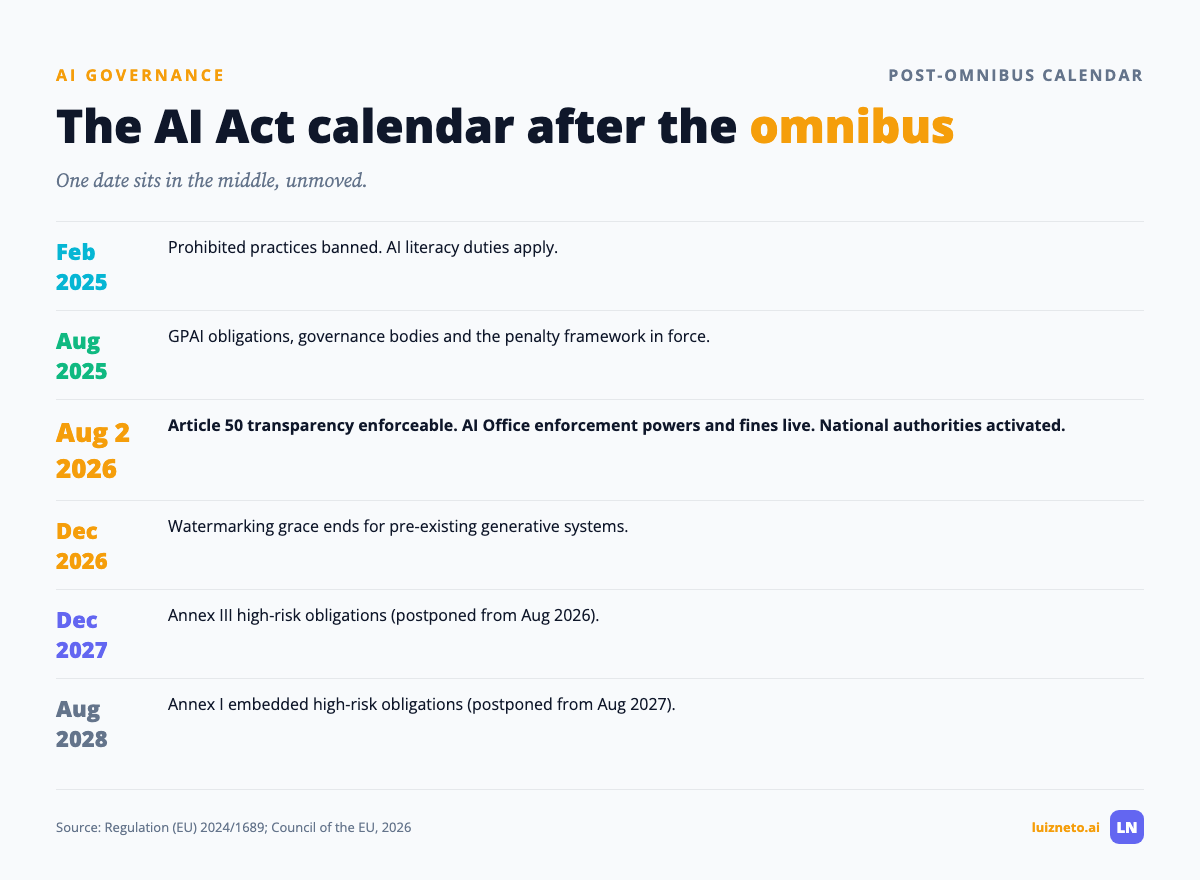
The timeline above is the one your program should be planned against. Note what sits in the middle of it, alone, unmoved.
Transparency duties are also where AI agents complicate the picture. The more autonomy you give a system that talks to customers, the more disclosure surfaces you create. I covered that trajectory in how agentic AI transforms enterprise decision-making. The next section explains who gets to check your homework.
Enforcement stops being theoretical
The obligations for general-purpose AI models have technically applied since August 2, 2025. For a year, nobody could be fined under them. That grace year ends now.
From August 2, 2026, the Commission's AI Office holds fully operable enforcement powers over GPAI providers (Regulation (EU) 2024/1689). It can demand documentation under Article 91. It can order independent technical evaluations of models under Article 92, including access through APIs. It can require corrective measures, and in serious cases restrict or pull a model from the EU market under Article 93.
And it can fine. Up to €15 million or 3% of worldwide annual turnover, whichever is higher, for GPAI non-compliance (Regulation (EU) 2024/1689, Article 101).
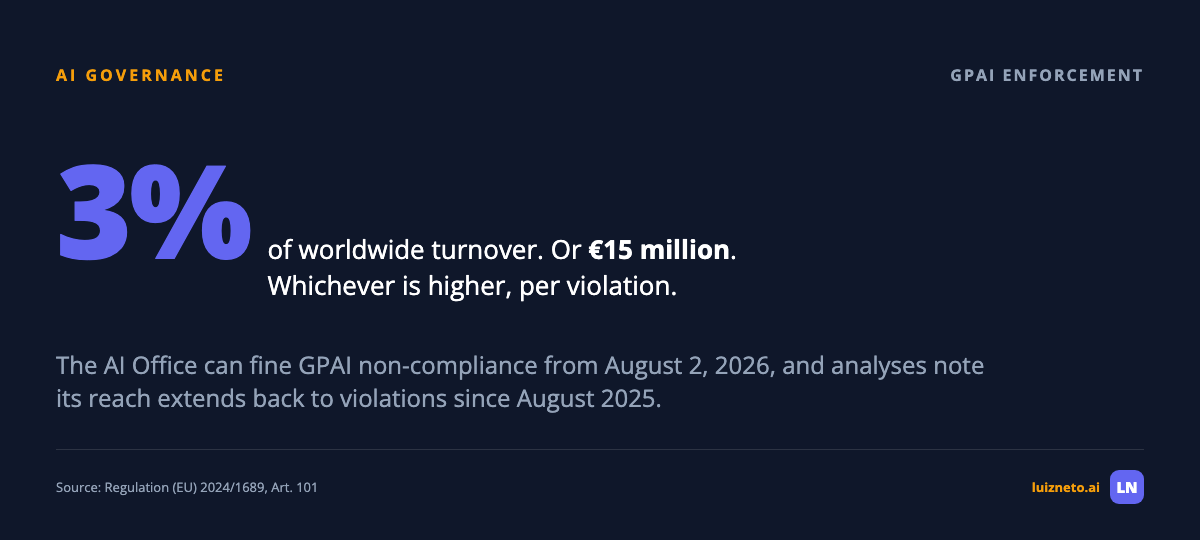
One property of this regime deserves more board attention than it gets: analyses of the enforcement framework note the Commission can sanction violations dating back to August 2025 once its powers go live (enforcement analyses, 2026). In practice the grace year functioned as a filing period.
The AI Office spent that year building its toolbox. It published the GPAI Code of Practice, refined documentation formats, defined evaluation and adversarial-testing practices, and set up the data-access channels it will use for formal investigations. A regulator that spends twelve months preparing instruments tends to use them. If your organization builds on foundation models, the practical question is no longer whether your provider complies. It is whether you can demonstrate which models you depend on, under what terms, and what your own duties are when their obligations cascade down to you as a deployer.
National authorities activate on the same date. From August 2, member-state market surveillance authorities gain formal enforcement powers over AI literacy duties, prohibited practices, and the Article 50 transparency obligations (AI Act deadline trackers, 2026). Enforcement stops being a Brussels abstraction and becomes a local inspector with jurisdiction.
The large model providers saw this coming. Roughly two dozen organizations signed the GPAI Code of Practice, including OpenAI, Anthropic, Google, Microsoft, Amazon and Mistral AI (signatory trackers, 2026). Signing buys a presumption of conformity. If the companies with the largest legal budgets in technology chose the safe harbor, that tells you how they price the alternative.
Regulatory direction diverges sharply by region, and the contrast with Washington's approach is worth keeping in view. I wrote about it in the AI policy agenda unveiled at the World Economic Forum. What has not diverged is the readiness of the companies these regimes apply to. The numbers are worse than you think.
The readiness numbers no one wants to own
Strip away the vendor surveys that flatter their buyers and the picture is stark.
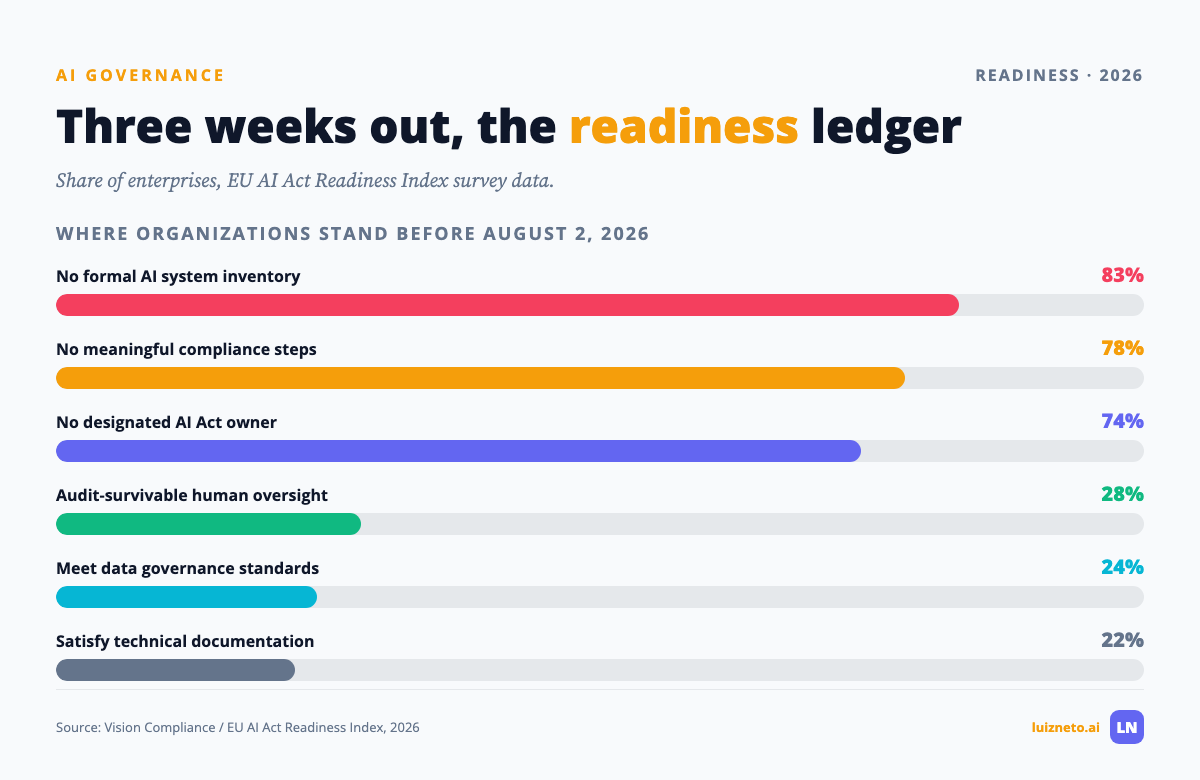
78% of organizations have taken no meaningful steps toward AI Act compliance, across a 2026 survey of eight EU industries (Vision Compliance, 2026). Not "behind schedule." No meaningful steps.
It gets more specific, per the EU AI Act Readiness Index, 2026:
- 83% have no formal inventory of the AI systems they use or deploy.
- 74% have no designated internal owner for AI Act obligations.
- 28% have human oversight capabilities that would survive an audit.
- 24% meet the Act's data governance standards. 22% satisfy its technical documentation requirements.
Independent data corroborates the worst of it. The Cloud Security Alliance found more than half of surveyed organizations lacked a basic inventory of the AI systems they operate as of March 2026 (Cloud Security Alliance, 2026). McKinsey's State of AI research puts enterprise-wide responsible AI councils at 18% of organizations (McKinsey, 2025). And only 8% of organizations globally run a comprehensive AI governance program, while 88% actively use AI across business functions (EU AI Readiness Index, 2026).
Sit with the shape of that. Nine in ten companies run AI in production. Fewer than one in ten governs it end to end. Fewer than two in ten can even list what they are running.
You cannot label what you have not inventoried. You cannot disclose an AI interaction you do not know exists. Every Article 50 duty presumes a capability that four out of five enterprises told surveyors they do not have.
The authorities get their powers on August 2. On the current numbers, most enterprises will meet them without so much as a list of their own AI systems.
What non-compliance actually costs
The AI Act prices violations in three tiers, and the ceilings are set against global turnover, not EU revenue.
| Violation | Maximum fine | Turnover alternative | Legal basis |
|---|---|---|---|
| Prohibited AI practices | €35,000,000 | 7% | Article 99(3) |
| High-risk and most other obligations, including Article 50 transparency | €15,000,000 | 3% | Article 99(4) |
| GPAI provider obligations | €15,000,000 | 3% | Article 101 |
| Misleading information to authorities | €7,500,000 | 1% | Article 99 |
| Whichever is higher for ordinary undertakings; SMEs capped at the lower figure. Source: Regulation (EU) 2024/1689, 2024 | luizneto.ai | |||
Three properties of this table matter for how you budget. The ceilings bind against worldwide turnover, so an EU subsidiary does not contain the exposure. The transparency duties arriving in August sit in the €15 million tier, not some minor administrative bucket. And the misleading-information tier means the response to an authority's first letter is itself a regulated act.
Fines are the headline number. Compliance spend is the quieter one, and it compounds with delay.
Published estimates for a single high-risk system run from €46,500 to €94,000 in first-year compliance for a lean startup model, with €15,000 to €35,000 in ongoing annual cost (Wavect, 2026). Large-enterprise analyses put the average annual cost near €52,000 per high-risk system, and organization-level first-year programs at €8 million to €15 million (InformedClearly, 2026). The Cloud Security Alliance lands in the same range for large enterprises: $8 million to $15 million to close inventory, documentation and monitoring shortfalls (Cloud Security Alliance, 2026).
Here is the honest downside of acting now: you will spend real money on plumbing nobody celebrates, and the high-risk dates you are preparing for may still shift again. The investor logic holds anyway. The transparency work due in August is a fraction of that budget, and every month of delay converts routine work into premium-priced remediation. Markets reprice fast when the ground moves, as the DeepSeek shock demonstrated. Regulators reprice slower, but they do not forget the year you knew and did nothing.
Person A and Person B on August 2
Two enterprise AI leads read the same headline on June 29.
Person A reads "high-risk obligations postponed to December 2027" and stands the program down. The AI inventory project loses its sponsor. The chatbot disclosure work slides to next year's budget. The board hears "we now have eighteen months of runway."
Person B reads the Council text itself. She notices the postponement names Annex III and Annex I, and nothing else. She keeps the inventory sprint alive, maps every customer-facing AI touchpoint against Article 50, and adopts the Transparency Code of Practice as her implementation template.
On August 2, an authority with fresh powers asks both organizations the same first question. Not their conformity assessments. The simple one: what AI systems are you running, and where do users interact with them?
Person B answers from a live register in an afternoon.
Person A starts an email chain asking who owns the list. There is no list. There is an 83% chance there was never a list (EU AI Act Readiness Index, 2026).
The 20-day sprint
This is the response I would run against the EU AI Act deadline, sequenced for the time remaining. It is deliberately narrow. It covers the surfaces that become enforceable in August, not the full high-risk program you now have until December 2027 to build properly.
A note on scope before the steps. If your organization neither builds foundation models nor deploys AI that touches people, your August exposure is small and your work is confirmation, not construction. Almost nobody reading this is in that category. The 88% of organizations using AI across business functions, per the EU AI Readiness Index, 2026, are almost all running at least one system Article 50 reaches.
First, build the inventory. One week, one spreadsheet if that is what it takes. Every AI system in production or pilot, who owns it, and whether it touches customers, employees or the public. This single artifact addresses the failure mode 83% of organizations share, and every later obligation depends on it.
Second, run the Article 50 surface scan. From the inventory, flag every point where a person interacts with AI, sees AI-generated content, or is subject to emotion recognition. Chatbots, voice agents, content pipelines, sentiment tooling. Each flag is a disclosure you owe by August 2.
Third, implement disclosure and labeling against the Code of Practice. The June 10 Transparency Code is the template regulators themselves published. Use it. Interaction notices on conversational systems. Provenance labels on synthetic media. Editorial accountability rules for AI-drafted public text. Pre-market generative systems get until December 2, 2026 for watermarking, so sequence that work second, not first.
Fourth, name the owner and train the operators. Appoint the single accountable owner three quarters of enterprises lack, and put AI literacy training in front of every team deploying these systems. Literacy obligations have applied since February 2025, and national authorities can now enforce them.
| Days | Move | Output |
|---|---|---|
| 1 to 7 | AI system inventory | Live register: system, owner, exposure surface |
| 8 to 12 | Article 50 surface scan | Disclosure obligations list per touchpoint |
| 13 to 18 | Disclosure and labeling rollout | Interaction notices and content labels, per the Transparency Code |
| 19 to 20 | Ownership and literacy | Named AI Act owner, training plan filed |
| Scope: obligations enforceable from 2026-08-02. Sources: Regulation (EU) 2024/1689; European Commission Transparency Code, 2026 | luizneto.ai | ||
Twenty days is enough for this scope. It is not enough for the high-risk program, which is precisely why the sixteen months the omnibus gave you should start now, from an inventory you will already have.
The mechanism is simple. Inventory tells you where you stand. The surface scan converts it into obligations. The Code of Practice converts obligations into implementations. The owner keeps all three alive after the deadline passes. Run that chain and August 2 becomes a date you report on instead of a date you explain.
Frequently asked questions
Did the EU AI Act get delayed?
Partially. The Digital Omnibus, approved by the Council on June 29, 2026, moves high-risk obligations to December 2, 2027 (Annex III) and August 2, 2028 (embedded systems). Transparency obligations, GPAI enforcement and penalties still begin August 2, 2026 (Council of the EU, 2026).
What applies under the EU AI Act on August 2, 2026?
Article 50 transparency duties become enforceable: disclosing AI interactions, labeling AI-generated content and deepfakes, and informing people about emotion recognition. The AI Office also gains full enforcement powers over general-purpose AI providers, including fines (Regulation (EU) 2024/1689).
What are the EU AI Act fines?
Three tiers. Prohibited practices reach €35 million or 7% of worldwide turnover, whichever is higher. High-risk, transparency and GPAI violations reach €15 million or 3%. Supplying misleading information to authorities reaches €7.5 million or 1%. SMEs are capped at the lower figure (Regulation (EU) 2024/1689).
What are Article 50 transparency obligations?
Duties to tell people when AI is in the loop: chatbot and voice-agent disclosure, labels on AI-generated or manipulated content including deepfakes, labels on AI-written public-interest text without editorial accountability, and notice when emotion recognition or biometric categorization runs (Regulation (EU) 2024/1689).
Who enforces the EU AI Act?
Two layers. The European Commission's AI Office directly supervises general-purpose AI providers, with document demands, model evaluations and fines from August 2, 2026. National market surveillance authorities enforce prohibitions, literacy and transparency duties in each member state (Regulation (EU) 2024/1689).
What should enterprises do before August 2, 2026?
Four moves: build a complete AI system inventory, scan it for Article 50 disclosure surfaces, implement interaction notices and content labels using the Commission's Transparency Code of Practice, and appoint a named AI Act owner with literacy training underway. High-risk conformity work follows on the 2027 timeline.
The AI Industrial Revolution is a governance story now. Subscribe at luizneto.ai for the enterprise playbook as the enforcement era begins, or start with why transparency pays for itself beyond compliance.
One question worth taking into your next steering committee: if an authority asked tomorrow for the list of AI systems your company runs, who would answer, and how long would it take?