Only 7% of Enterprises Have AI-Ready Data
AI adoption is near-universal and AI-ready data is a single-digit club: 5%, 7% or 19% depending on the definition. The 2026 census reconciled, why agents turned old data debt into visible failures, and the four artifacts the ready minority built before their first pilot.
Only 7% of Enterprises Have AI-Ready Data
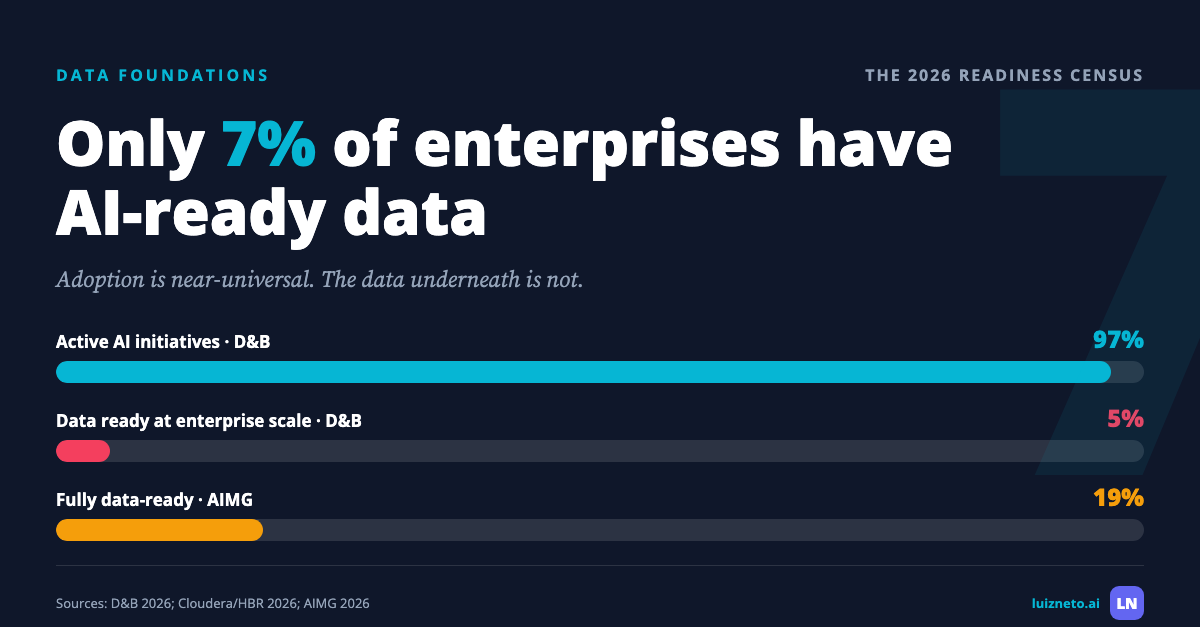
97% of organizations run active AI initiatives. 5% believe their data can support AI at enterprise scale (Dun & Bradstreet, 2026). Those two numbers describe the same companies in the same year, and the distance between them is where most AI budgets are quietly going to die.
AI-ready data is now the scarcest asset in enterprise AI, and the 2026 surveys finally measured how scarce.
By the end of this piece you will know what the three readiness numbers actually measure, why AI agents made old data debt suddenly visible, and the four things the ready minority built before their first pilot. The census table below is the version to bring to your next data budget conversation.
Key takeaways
- AI adoption is near-universal; data readiness is single-digit.
- The readiness numbers differ because the definitions differ.
- Agents fail loudest exactly where data debt lives.
- Unready data already cancels projects and erases EBIT impact.
- The ready 7% sequenced data work before any pilot.
Contents
- The 2026 AI data readiness census
- Three readiness numbers, three definitions
- Agents turned data debt into visible failures
- What unready data already costs
- What the 7% built before their first pilot
- The budget is finally moving
- The Monday readiness test
- AI-ready data FAQ
The 2026 AI data readiness census
Three large studies asked the readiness question this year, each with its own wording. Put side by side, they draw one picture with unusual consistency.
Dun & Bradstreet surveyed 10,000 enterprises: 97% have active AI initiatives, and only 5% say their data is ready to support AI at scale beyond pilots (D&B AI Momentum Survey, 2026).
Cloudera and Harvard Business Review Analytic Services asked 230-plus executives involved in AI data decisions: 7% say their data is completely ready for AI, and 73% say preparing data for AI has been challenging (Cloudera / HBR Analytic Services, 2026).
AI Markets Group benchmarked 2,048 enterprise decision-makers: 87% now use AI, 70% have adopted generative AI, and just 19% are fully data-ready (AIMG Enterprise AI 2026).
| Study | Adoption number | Readiness number | What "ready" meant |
|---|---|---|---|
| D&B AI Momentum Survey (10,000 enterprises) | 97% active initiatives | 5% | Data supports AI at enterprise scale, beyond pilots |
| Cloudera / HBR Analytic Services (230+ executives) | n/a | 7% | Data completely ready for AI adoption |
| AIMG Enterprise AI 2026 (2,048 decision-makers) | 87% use AI | 19% | Fully data-ready (self-assessed) |
| Sources: D&B 2026; Cloudera/HBR 2026; AIMG 2026 | luizneto.ai | |||
Read the adoption column, then the readiness column. The first says AI is as common as email. The second says the thing AI runs on is rarer than a working disaster-recovery plan.
Every executive I brief on these numbers asks the same first question: which one is right? That is the wrong question, and the next section shows why. The infrastructure that closes the distance is a solved problem, laid out in how to modernize data infrastructure for generative AI.
Three readiness numbers, three definitions
5%, 7%, 19%. All three are true, because each study set the bar at a different height.
D&B's 5% is the hardest test: data ready to support AI at enterprise scale, beyond pilots. That means other departments' formats, other regions' regulations, other systems' quirks. Almost nobody passes.
Cloudera and HBR's 7% is "completely ready for AI adoption", a self-assessment against the respondent's own ambitions. A slightly lower bar, a slightly bigger club.
AIMG's 19% is "fully data-ready" as decision-makers rate themselves. The most generous framing on the most optimistic audience still leaves four out of five enterprises admitting they are not there.
The definitions differ in exactly the way pilots differ from production. A pilot consumes one team's dataset, hand-cleaned for the occasion by the people who want the demo to work. Scale means the same system consuming finance's spreadsheets, the field organization's free-text notes, and a decade of acquisitions' half-migrated records, with nobody cleaning anything by hand. D&B's question priced that second reality, which is why its number is the smallest.
Self-assessments drift optimistic for a second reason: the person answering usually owns the data program being graded. Even so, the most flattering number in the census still fails 81% of respondents. When the generous measure and the harsh measure agree on the conclusion, the conclusion is safe to plan on.
If this move looks familiar, it should. Readers of this week's piece on why AI agent statistics disagree saw the same pattern: conflicting numbers that reconcile the moment you name what each one measures. The lesson transfers whole. When a readiness statistic arrives without its definition, ask for the definition before you accept the number.
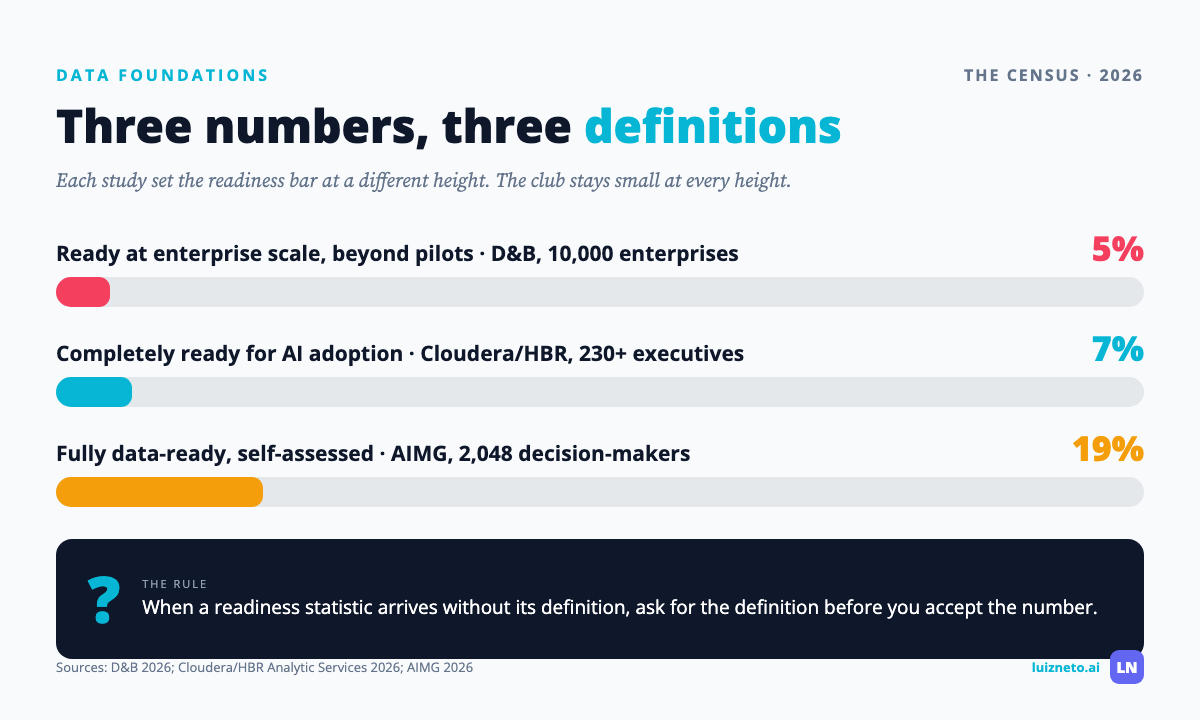
The practical reading: wherever your organization sets its own bar, the honest pass rate sits somewhere between one in twenty and one in five. Plan against that base rate, and the next two sections tell you what happens to the majority that does not.
Agents turned data debt into visible failures
Data quality has been a known problem for two decades. What changed in 2026 is that AI agents started consuming data without a human in between, and the debt stopped being deferrable.
The production evidence is specific. Foundra's telemetry across deployed agents found a roughly 37% performance drop between benchmark and enterprise deployment, with failures clustering at handoff boundaries, on messy inputs, and in monitoring blind spots rather than in raw model capability (Foundra, 2026).
Ask enterprises directly and they name the same culprit. 42% cite data quality and provenance as the top hurdle to agentic AI, ahead of regulation and ahead of security (Agentic AI Readiness Index, 2026).
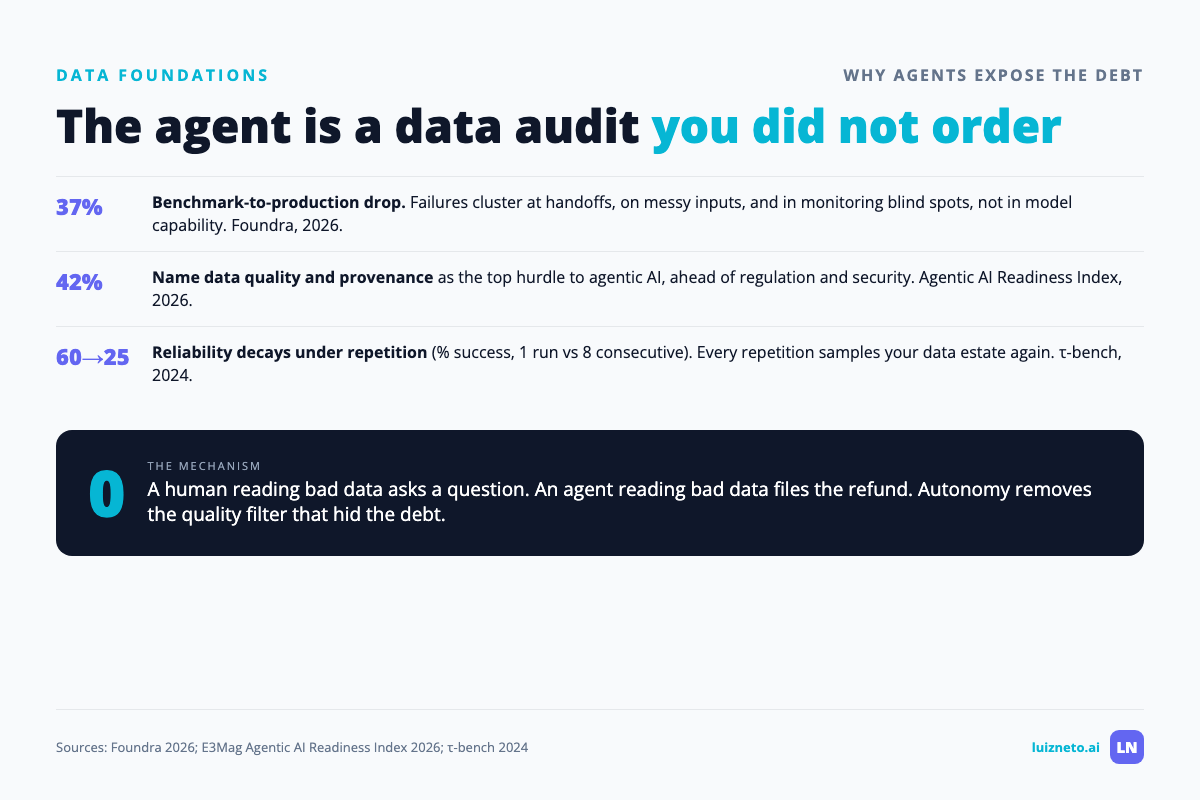
Here is the mechanism, stated plainly. A dashboard reads bad data and shows a wrong number; a human squints at it and asks a question. An agent reads the same bad data and files the refund, updates the CRM, or emails the customer. The human was the data-quality control layer, and autonomy removes it.
Reliability work makes this worse before it makes it better. Agents that pass a task once collapse under repetition, from roughly 60% success on a single run to roughly 25% across eight consecutive runs (τ-bench, Sierra, 2024). Every one of those repetitions samples your data estate again. The messier the estate, the faster the decay compounds.
The monitoring finding deserves its own sentence, because it is the expensive one. When an agent consumes a wrong-but-plausible value, nothing errors: the action completes, the log line looks healthy, and the failure surfaces weeks later as a customer complaint or an audit flag. Bad data plus autonomy does not produce louder failures. It produces quieter ones, further from the source, harder to trace back.
That trace-back is precisely what lineage buys. An organization with lineage turns "the agent said something wrong" into a fifteen-minute lookup of which upstream field drifted. An organization without it convenes a meeting.
My read of this year's evidence: an agent is a data audit you did not order. It walks your systems, finds every null, every merged header, every undocumented field, and publishes the findings as customer-visible failures. The operating model that contains this is covered in the enterprise agent control plane.
What unready data already costs
The costs are no longer hypothetical. Three sourced numbers put a price on skipping the data work.
Gartner forecasts that 60% of AI projects without AI-ready data will be abandoned through 2026 (Gartner, cited in the Cloudera/HBR coverage, 2026). Abandonment is the loud, visible version of the cost.
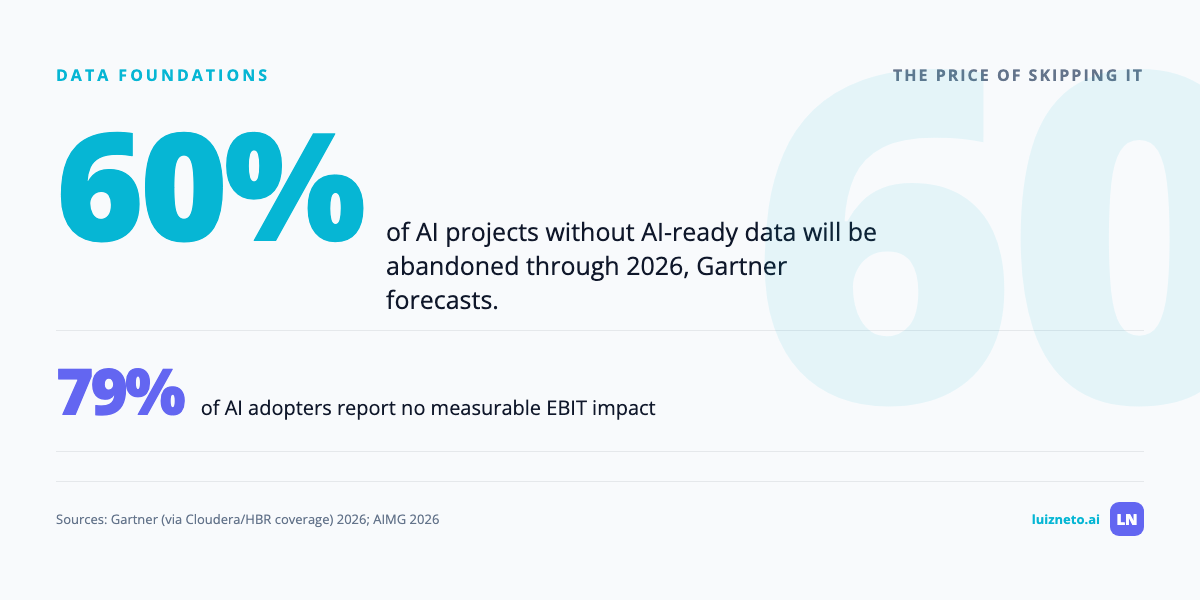
There is also a quiet version: impact that never shows up. Among AI adopters, 79% report no measurable EBIT impact (AIMG, 2026). And the scaling funnel starves at the same point: 78% of enterprises have an agent pilot running while only 14% have scaled one organization-wide (Teradata / Wakefield Research, 2026).
The stall shows up exactly where the definitions predicted. A pilot runs on the curated slice, so 78% of enterprises can get one moving. Scale runs on the estate as it actually is, and the estate is what 5% called ready. Read together, the funnel number and the readiness number are the same fact measured twice: the pilot-to-scale wall IS the data wall, wearing an agent costume.
Consider two leaders with identical budgets. Person A spends on model subscriptions and agent licenses first, because that is what the demo showed. The pilots sparkle, the rollout meets other teams' data, and the program joins the 79% with nothing on the EBIT line. Person B spends the first two quarters on ownership, catalogs and lineage, ships the pilot late, and scales it without drama, because the estate underneath was already load-bearing.
Adoption is a purchase. Readiness is a construction project. The 2026 numbers say enterprises made the purchase and skipped the construction.
Person A is not careless; the incentives point that way. A model upgrade arrives as a purchase order with a demo attached, while data work arrives as engineer-quarters with nothing to show on a screen. Budget flows toward whatever can be shown on a screen, which is the same dynamic that stalls enterprise AI programs without a model portfolio strategy.
What the 7% built before their first pilot
The most useful finding in the Cloudera and HBR research is what the 7% had in common, more than the number itself.
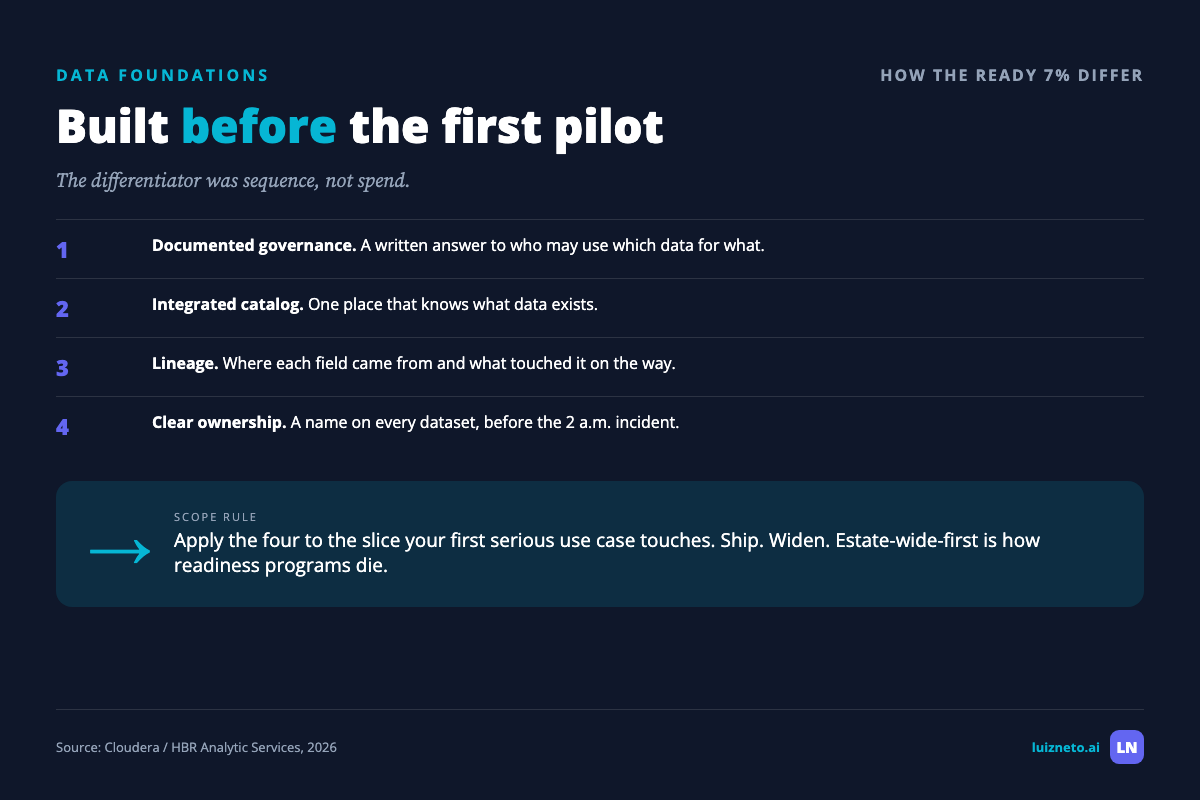
The data-ready group had documented governance, integrated catalogs, lineage, and clear data ownership in place before they shipped a pilot (Cloudera / HBR Analytic Services, 2026). Before. Not alongside, not retrofitted after the first incident.
Walk the four as an engineer would.
Documented governance. A written answer to who may use which data for what. Without it, every AI use case starts with a meeting; with it, most start with a lookup.
An integrated catalog. One place that knows what data exists. This is the readiness twin of the AI-system inventory that compliance work demands: you cannot feed an agent from an estate you cannot list.
Lineage. Where each field came from and what touched it on the way. Lineage is what turns an agent's wrong answer from a mystery into a ticket.
Clear ownership. A name on every dataset. When the agent files the wrong refund at 2 a.m., ownership is the difference between a fix and a war room.
Notice what is absent from that list: platform purchases, model choices, vendor names. The differentiator is sequence and discipline, not spend. The step-by-step version of this build is in how to prepare enterprise data for AI success.
One caution on scope, because "fix the data first" has sunk programs of its own. The 7% did not boil the whole estate before piloting. The artifacts apply to the slice of data the first serious use case touches: govern, catalog, trace and assign THAT, ship, then widen. Readiness built use case by use case compounds; readiness pursued estate-wide up front becomes the multi-year program that gets cancelled at the first budget review.
The budget is finally moving
There is genuine good news in the 2026 data: the spending pattern has started to correct.
86% of data leaders plan to increase data management investment this year, with privacy and security (43%) and AI governance (41%) as the top drivers (Informatica CDO Insights, 2026). The money is heading toward the unglamorous layer for the first time in the AI cycle.
The distance it has to cover is still long. Among CIOs and CTOs, 55% report that fewer than half of their core applications are AI-ready (Cloudera / HBR Analytic Services, 2026). The estate that agents will actually touch, meaning the ERP, the CRM and the ticketing system, is the estate least prepared for them.
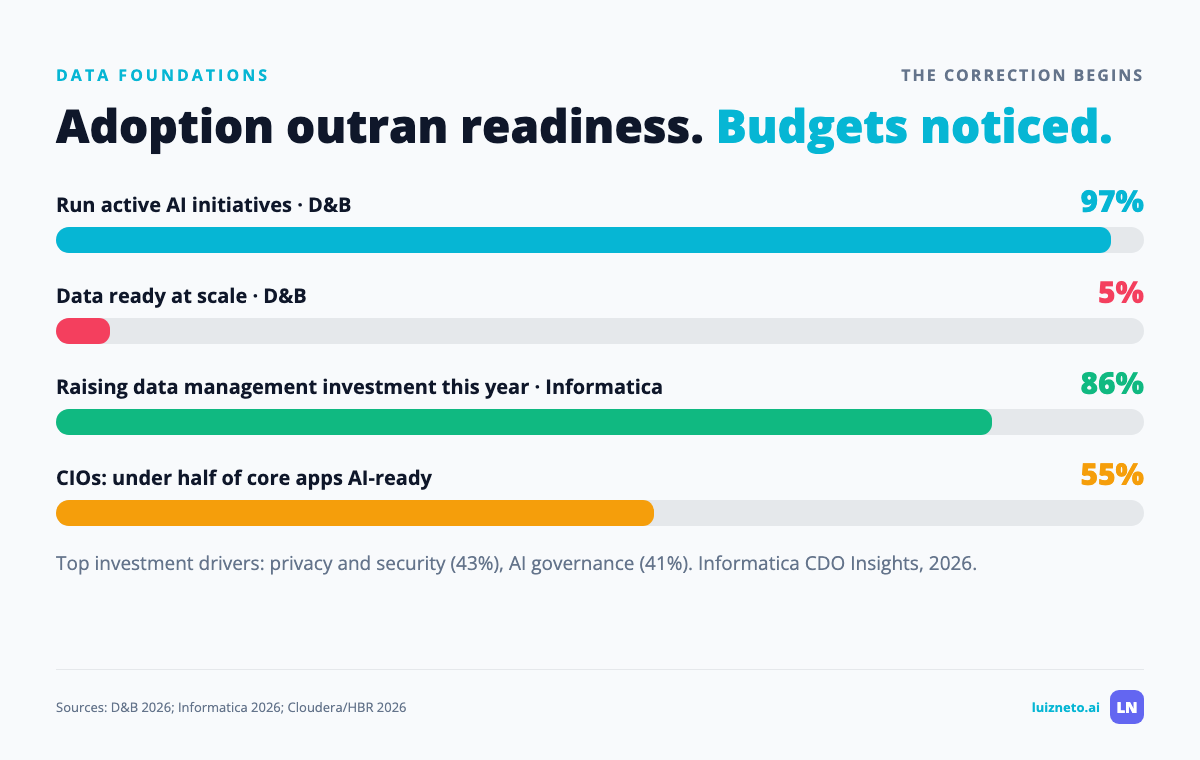
Read the 55% next to Gartner's abandonment forecast and the sequencing logic becomes financial. Projects built on unready data are the ones in the 60% attrition pool, so every dollar spent making a core application AI-ready is effectively insurance on every AI dollar that touches it afterward. The order of operations is the return.
The investor framing makes the opportunity concrete. Readiness is currently mispriced: the market pays premium prices for model access anyone can buy, while the asset that decides whether models produce EBIT, which is governed, catalogued, owned data, stays scarce, unglamorous and cheap to build relative to what it makes possible. Scarce and mispriced is normally where returns live.
Boards are starting to ask the right questions about the agents; the same scrutiny needs to reach the data underneath them. The question set is in the five questions every board should ask about AI agent governance.
The Monday readiness test
Five questions, each answerable inside a week, each mapped to a number in this article. Score one point per confident yes.
- Can you list your core applications and say which are AI-ready? 55% of CIOs admit fewer than half are; most cannot produce the list itself.
- Does every dataset an AI system touches have a named owner? Ownership was one of the four before-pilot artifacts of the ready 7%.
- Could you trace a wrong agent answer back through lineage in under a day? If not, every incident becomes an investigation.
- Can you state the provenance of the data your agents consume? 42% of organizations name exactly this as their top agentic hurdle.
- Could finance attribute one EBIT line to an AI system today? 79% of adopters cannot; instrumenting value is data work too.
Four or five: you are plausibly in the single-digit club, and your constraint is ambition. Two or three: you are the 73% who call data preparation a struggle, and the four artifacts above are your next two quarters. Zero or one: pause the next agent purchase. It would only audit you.
Re-run the five questions quarterly. Readiness decays the way reliability does: every new data source, acquisition and pipeline change re-opens the estate, and a score that held in January can be fiction by June. The test costs an hour. The false confidence it removes costs nothing to lose.
The wider adoption context, and why appetite keeps climbing regardless, is in the state of AI agents in 2026.
AI-ready data FAQ
What is AI-ready data?
Data an AI system can consume safely without a human quality filter: governed by documented rules, findable in an integrated catalog, traceable through lineage, and owned by a named person. The 2026 Cloudera/HBR research found the data-ready minority had all four in place before their first pilot.
What percentage of enterprises are data-ready for AI?
Between 5% and 19%, depending on the bar. 5% say their data supports AI at enterprise scale (D&B, 2026), 7% call it completely ready (Cloudera/HBR, 2026), and 19% self-rate as fully data-ready (AIMG, 2026). Each study used a different definition, which explains the spread.
Why do AI projects fail because of data?
Gartner forecasts 60% of AI projects without AI-ready data will be abandoned through 2026. Production telemetry shows agents lose roughly 37% of benchmark performance in deployment, failing on messy inputs, handoffs and monitoring blind spots, the exact places where data debt lives (Foundra, 2026).
How do you prepare data for AI agents?
Sequence the four before-pilot artifacts: documented governance, an integrated catalog, lineage, and named ownership per dataset. Agents consume data without a human filter, so validation moves in front of the model. Provenance matters most: 42% of organizations call data quality and provenance their top agentic hurdle.
What do data-ready companies do differently?
They sequence rather than outspend. The ready 7% built governance, catalogs, lineage and ownership before shipping any pilot (Cloudera/HBR, 2026), and the broader market is following: 86% of data leaders are increasing data management investment this year (Informatica, 2026).
Readiness is the position to take now
The 2026 census settles the diagnosis: adoption saturated, readiness did not, and agents are now stress-testing the difference in production. That makes the next two quarters unusually clear for anyone willing to do quiet work. Build the four artifacts on the narrow slice of data your first serious agent will touch, instrument the EBIT line before the pilot, and let the census table set expectations upstairs.
The companies that look slow this quarter, pouring budget into catalogs and lineage nobody demos, are positioning for the cycle where readiness gets priced correctly.
If this reconciliation is useful, the weekly analysis goes deeper. Subscribe to the newsletter for the data behind enterprise AI decisions, or start with the practical data-preparation framework.