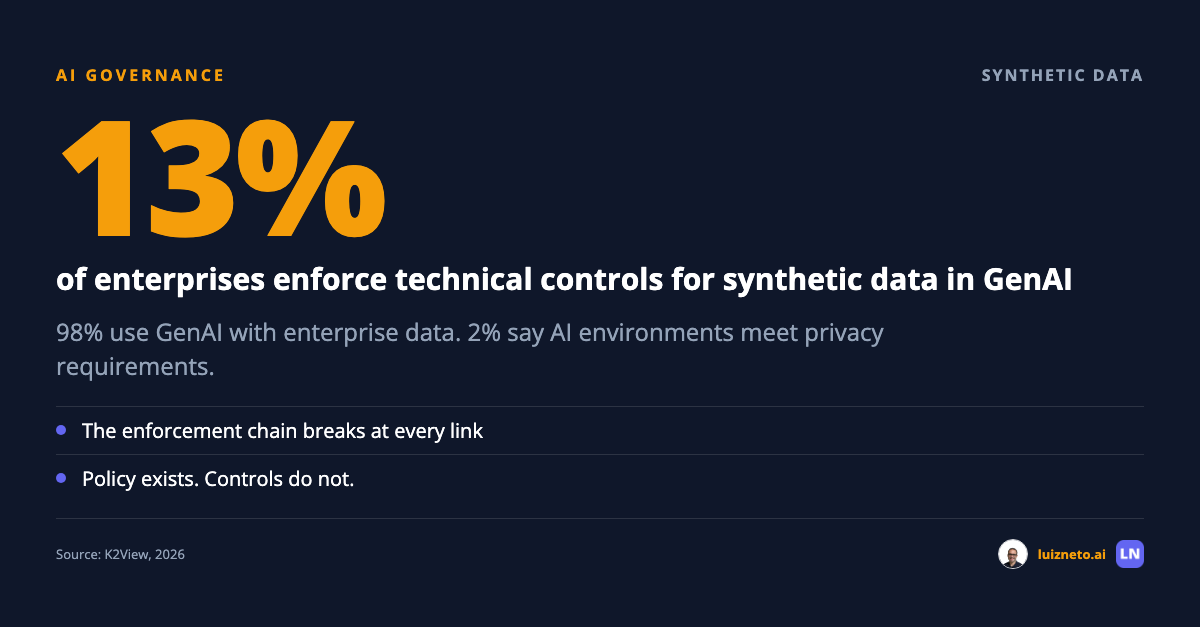
98% Use GenAI. 13% Enforce Synthetic Data Compliance.
98% of enterprises use GenAI with enterprise data. Only 13% have technical controls for sensitive data. This article maps the 4-link enforcement chain and delivers a framework to close each link before the next EU AI Act deadline.
98% Use GenAI. 13% Enforce Synthetic Data Compliance.
K2View's 2026 State of Enterprise Data Compliance surveyed enterprises on their GenAI governance. 98% use GenAI with enterprise data. 13% have a technical control preventing sensitive data from entering it.
The compliance policy exists. The enforcement does not.
That 85-point spread between adoption and enforcement is not a documentation problem. It is an engineering problem. Enterprises wrote acceptable-use policies, circulated training decks, and updated their risk registers. Then they shipped GenAI into environments where 87% of organizations still copy production data into non-production systems, and only 2% say their AI environments meet privacy standards.
This article maps the 4-link enforcement chain that breaks between GenAI policy and synthetic data compliance, names the evidence at every link, and delivers a framework to close each one before the next EU AI Act deadline arrives.
Subscribe to the weekly AI governance briefing so you can calibrate your compliance posture before the next enforcement wave lands.
Key Takeaways
- 98% use GenAI; only 13% enforce technical data controls.
- 2% of AI environments meet enterprise privacy standards.
- 79% reject synthetic data over realism concerns.
- EU AI Act Article 50 became enforceable August 2, 2026.
- A 4-step framework closes the policy-to-control enforcement chain.
Table of Contents
- The Number That Rewrites Enterprise AI Compliance
- Where Sensitive Data Actually Lives
- The Enforcement Chain That Breaks at Every Link
- Why Synthetic Data Compliance Stalls at Realism
- The EU AI Act Enforcement Timeline
- Dev and Test Environments Are the Unguarded Door
- The 4-Step Synthetic Data Compliance Framework
- Frequently Asked Questions
The Number That Rewrites Enterprise AI Compliance
Consider two enterprises. Both adopted GenAI in 2025. Both wrote compliance policies. Both updated their governance charters.
Enterprise A stopped there. It circulated the policy, trained its employees, and moved on. Its GenAI environments pull data from production databases, analytics platforms, and data lakes. Nobody audits what flows in.
Enterprise B did something different. It deployed a technical control at the boundary between its data infrastructure and its GenAI stack. Every query to an LLM passes through a policy engine that detects, masks, or substitutes sensitive fields before they reach the model.
Enterprise A is 87% of the market. Enterprise B is 13%.
The K2View compliance report quantified this enforcement failure across every environment type. The results are stark. 98% of enterprises report using GenAI with enterprise data. But only 13% have implemented technical controls that prevent sensitive data from entering LLM systems. And only 2% of enterprises say their AI environments fully meet data privacy requirements.
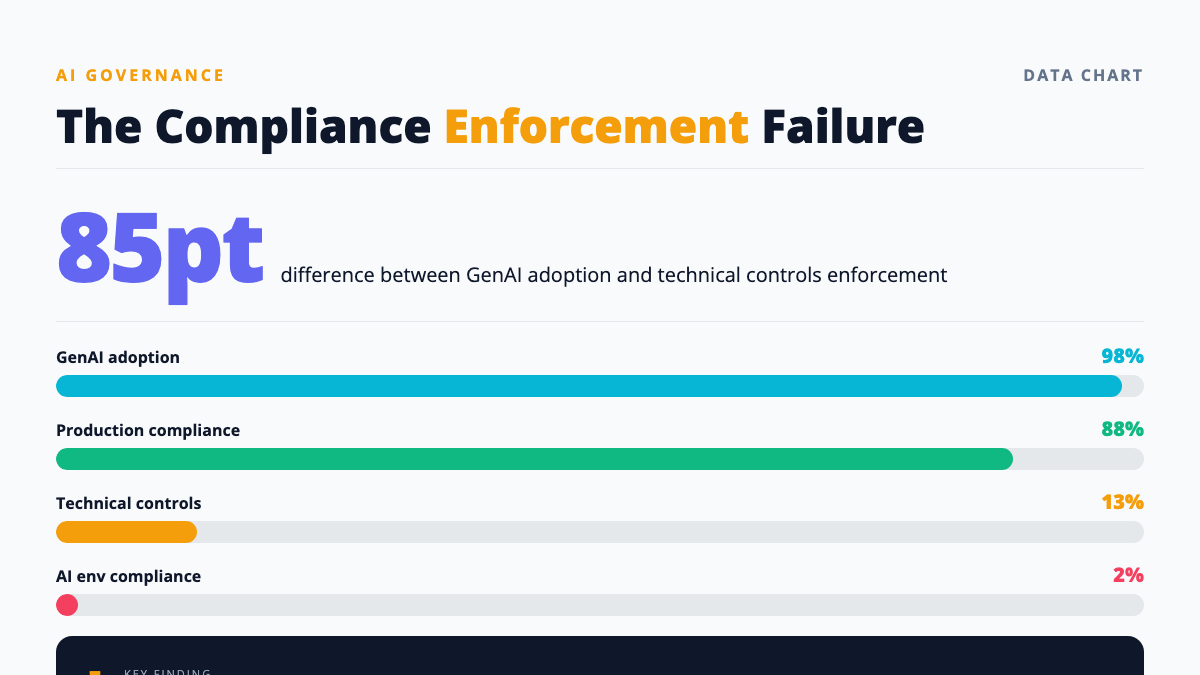
That 2% number is the lowest compliance score across any environment type in the survey. Production systems score 88%. SQL databases score 88% for data discovery confidence. AI environments score 2%.
The policy exists. The control does not. And the data flows regardless.
The EU AI Act Article 50 transparency obligations became enforceable on August 2, 2026. The deadline already landed. Here is what it requires.
Where Sensitive Data Actually Lives
The compliance perimeter at every enterprise is production. Access controls, encryption, audit logs, data classification. All built for the production database.
The data is not in production anymore.
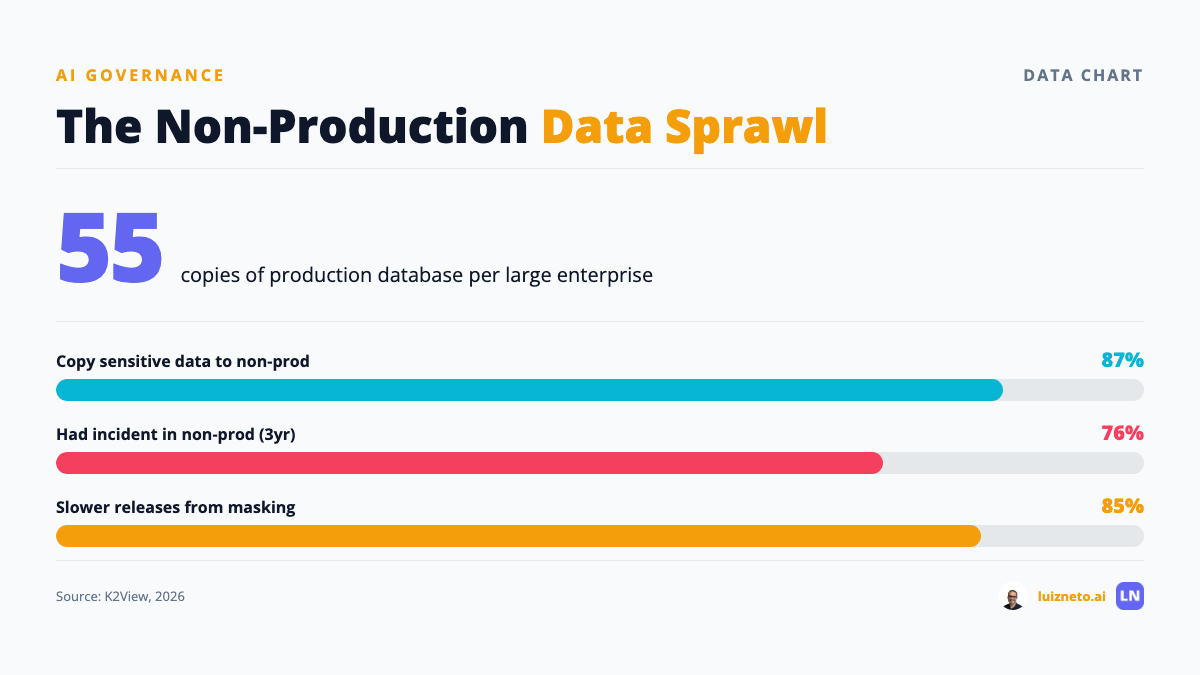
According to the K2View 2026 report, 87% of organizations copy sensitive data into non-production environments. Large enterprises with 10,000 or more employees maintain an average of 55 copies of their production databases across development, testing, analytics, and AI environments.
55 copies. Each one outside the compliance perimeter built for the original.
The problem compounds when you ask whether anyone knows where the sensitive data lives inside those copies. Only 9% of enterprises are fully confident they can discover sensitive data within their data lakes. Confidence drops to 13% for NoSQL databases and 2% for flat files (K2View, 2026).
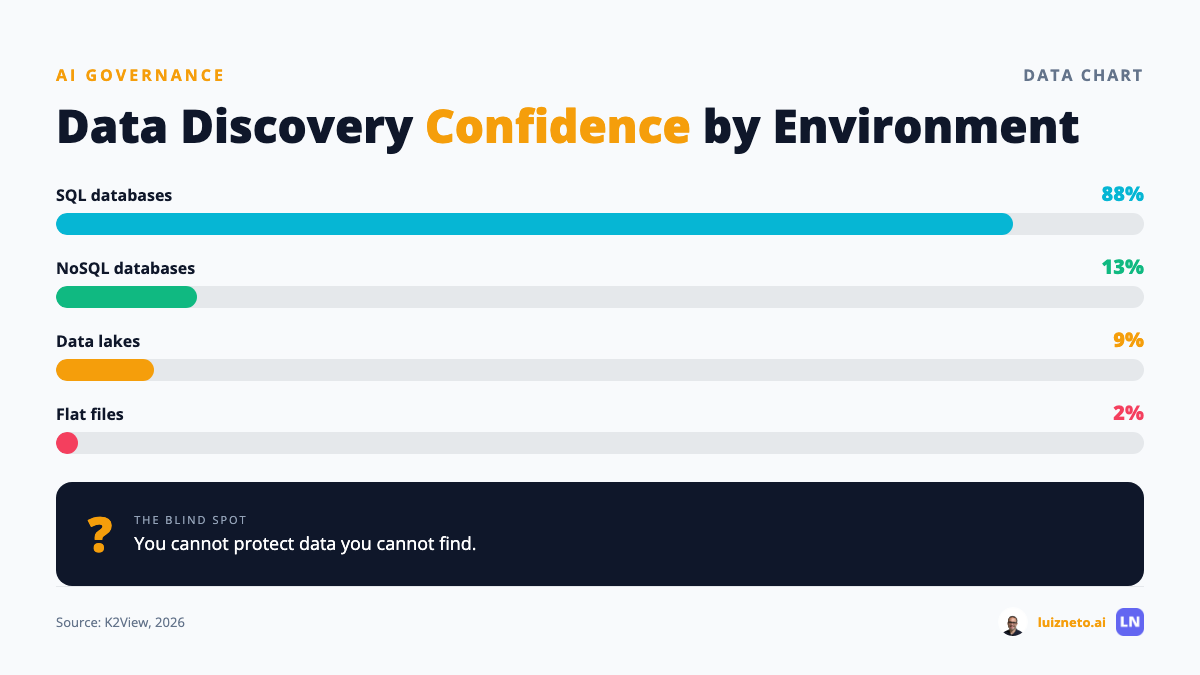
Think about that sequence. An enterprise copies sensitive data into 55 environments. It cannot find the sensitive data in most of those environments. It then connects a GenAI tool to those environments without a technical control at the boundary.
The result is predictable. 76% of organizations experienced a sensitive data incident in non-production environments within three years. 71% of those were internal compliance failures. 12% were ransomware or security incidents. 7% were confirmed data breaches (K2View, 2026).
The incidents are not coming from hackers breaking into production. They are coming from the organization's own data pipeline copying unmasked records into environments nobody governs.
This is the compliance perimeter problem. Every dollar of security investment protects the production database. But the data already left. It was copied into a staging environment for load testing, a data lake for analytics, a sandbox for a GenAI proof of concept. Each copy inherits the schema and the values. None of them inherit the controls.
The Enforcement Chain That Breaks at Every Link
Enterprise data compliance is a chain with four links. Every link must hold for the chain to work. In practice, every link breaks.
Link 1: Policy. The acceptable-use policy says sensitive data must not enter GenAI systems. 98% of enterprises have this policy or something like it. But a policy is a document, not a control. It tells people what not to do. It does not prevent them from doing it.
Link 2: Discovery. Before you can protect sensitive data, you need to find it. Only 9% of enterprises are fully confident they can discover sensitive data in data lakes (K2View, 2026). If you cannot find the data, you cannot classify it. If you cannot classify it, you cannot mask it. If you cannot mask it, you cannot substitute it with synthetic records.
Link 3: Control. Technical controls sit at the boundary between data infrastructure and the GenAI application. They intercept queries, detect sensitive fields, and either mask them, substitute synthetic records, or block the request. Only 13% of enterprises have deployed these controls. The other 87% rely on employee behavior and written policies to keep sensitive data out of LLM prompts.
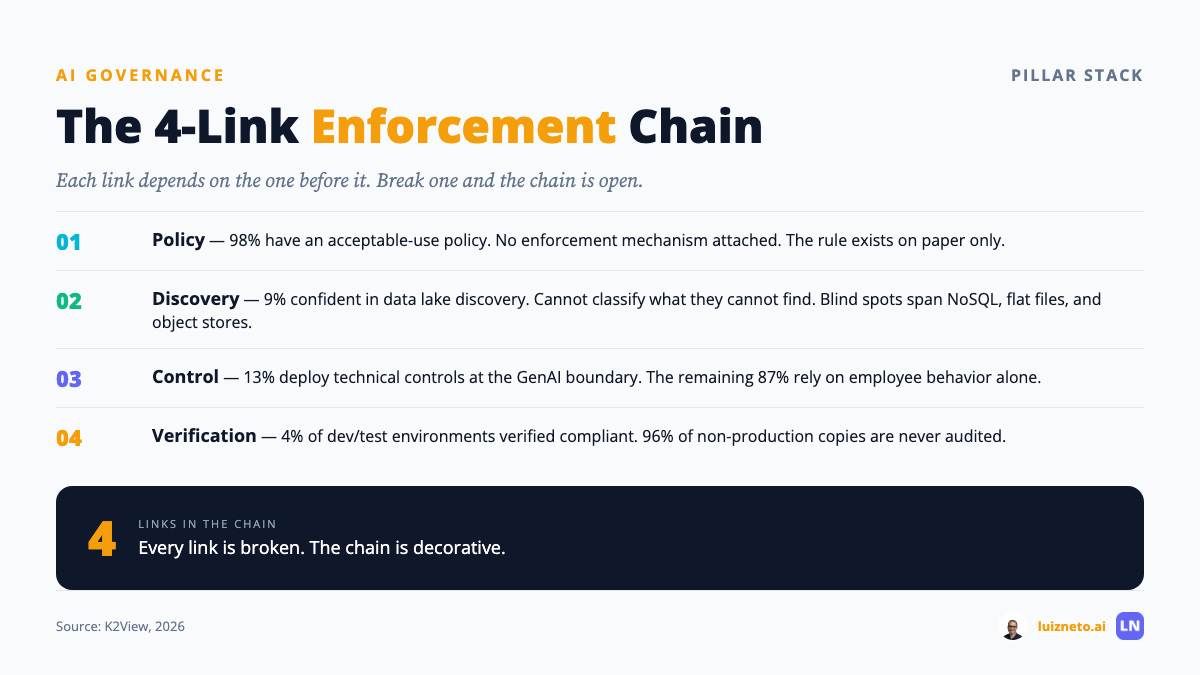
Link 4: Verification. Even when a control is in place, the enterprise needs to verify that it is working. Only 4% of development and test environments are fully compliant with data privacy requirements (K2View, 2026). That means 96% of the environments where synthetic or masked data should be used instead of production data are not verified as compliant.
The chain breaks at every link. The policy exists but has no enforcement mechanism. Discovery is too weak to identify what needs protection. Controls are absent in 87% of organizations. And verification covers only 4% of the environments that need it.
Enterprise B, the 13%, solved this by treating compliance as an engineering constraint, not a governance document. It embedded technical controls into the data pipeline, automated discovery with continuous scanning, and validated synthetic substitution against decision-grade quality thresholds.
Enterprise A treated compliance as a policy outcome. It hired a governance team, published a framework, and moved on to the next board presentation.
Do you see the enforcement pattern?
The enforcement chain breaks at discovery, control, and verification. If your compliance program starts and ends at policy, you have addressed 1 of 4 links. Subscribe to the weekly briefing so you can track the tools and techniques closing the other three.
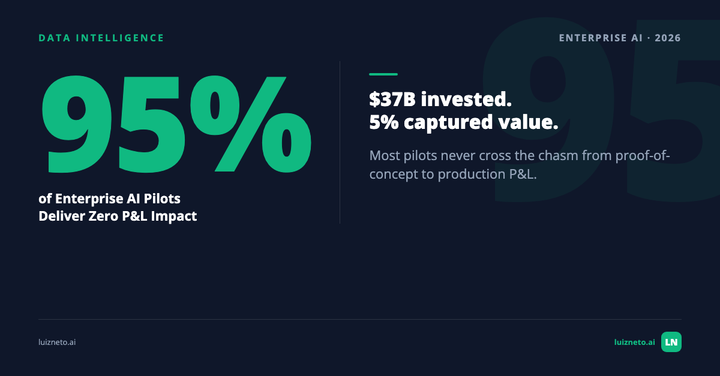
Enterprise AI pilots deliver zero P&L impact when governance breaks before production reaches scale.
Why Synthetic Data Compliance Stalls at Realism
Synthetic data is the obvious fix. Generate records that preserve the statistical patterns of real data without containing any real individual's information. Use those records for development, testing, analytics, and GenAI training. The sensitive data never leaves the production perimeter.
79% of enterprises cite realism and accuracy concerns as their primary barrier to adopting synthetic data (K2View, 2026).
That concern is not unfounded. Burke's FAR Framework, published in June 2026, tested LLM-generated synthetic panels against real respondent data. LLM synthetic data reached approximately 80% accuracy. It produced false conclusions in roughly 60% of tested business scenarios.
80% accuracy sounds reasonable until you run a business decision on it. A false conclusion rate of 60% means the synthetic data is worse than a coin flip for decision-grade applications. Burke's framework evaluates three dimensions: Fidelity (alignment with source truth), Authenticity (realistic variation), and Resolution (preserved variable relationships). LLM synthetic panels failed on Resolution, the dimension that matters most for business conclusions.
| Framework | Focus | Key Finding | Maturity |
|---|---|---|---|
| Burke FAR Framework (2026) | Decision-grade quality | 80% accuracy, 60% false conclusions in LLM synthetic panels | Published, enterprise-ready |
| IEEE "Toward Practical Anonymity" (2025) | Privacy risk and legal standards | No universal standard for synthetic data anonymity exists | White paper, standards pending |
| SEAL Ethics Audit Loop (2026) | Fairness, bias detection, audit trails | Standardized audit trails for regulatory mapping | Academic, domain-specific (6G) |
Sources: Burke, 2026; IEEE Standards, 2025; Khowaja et al., 2026
The IEEE White Paper "Toward Practical Anonymity" (October 2025) addressed the legal dimension. Structured synthetic data lacks universal standards for determining anonymity under existing legal frameworks. The paper recommended industry-wide standard-setting initiatives and formal definitions for privacy-preserving data synthesis. As of August 2026, those standards do not exist.
The SEAL framework (Khowaja et al., April 2026) demonstrated that embedding fairness checks, bias detection, and standardized audit trails directly into synthetic data pipelines is technically feasible. The implementation was domain-specific (6G networks), but the architecture is transferable: an ethics audit loop that validates synthetic output against regulatory requirements before it enters production.
Here is the tension at the center of this problem. Enterprises reject synthetic data because it reaches 80% accuracy. They accept production data in AI environments where 2% meet compliance standards. The bar for the fix is higher than the bar for the risk.
That asymmetry is the real barrier. The quality concern is valid. The response to it is not. An 80%-accurate synthetic dataset in a governed pipeline is safer than a 100%-accurate production dataset in an ungoverned one.
The quality measurement problem is solvable. The data exposure problem compounds every quarter it goes unaddressed. Every new GenAI deployment that connects to an ungoverned environment adds another vector. Every copy of the production database that moves into a test sandbox without masking adds another incident waiting to happen. The longer you wait for perfect synthetic data, the more production data leaks through the environments you are not watching.
The EU AI Act Enforcement Timeline
The regulatory pressure is no longer theoretical. It arrived 11 days ago.
The EU AI Act Article 50 transparency obligations became fully applicable on August 2, 2026. Providers of AI systems that generate synthetic audio, image, video, or text must ensure outputs are marked in a machine-readable format and detectable as artificially generated. The technical solutions must be effective, interoperable, durable, and reliable.
Non-compliance carries fines of up to €15 million or 3% of global annual turnover, whichever is higher (European Commission, 2026).
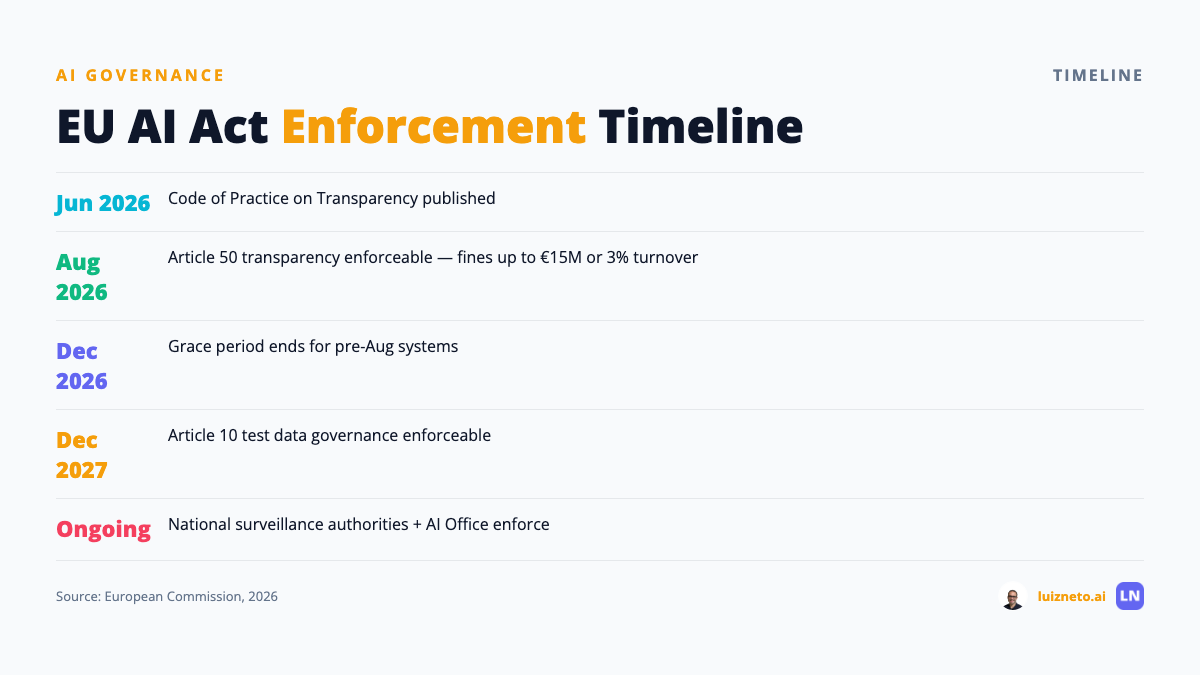
AI systems already on the market before August 2 received a grace period until December 2, 2026. Four months to implement watermarking, metadata tagging, and machine-readable marking. The Code of Practice on Transparency of AI-Generated Content, published on June 10, 2026, provides voluntary compliance guidance. Organizations that did not sign by July 27 must demonstrate compliance through other means.
Article 10, which governs data governance for training, validation, and testing datasets in high-risk AI systems, was deferred to December 2027. That is 16 months away. Article 10 requires datasets to be relevant, sufficiently representative, free of errors, and complete. It requires technical documentation proving compliance.
The enforcement sequence matters. Article 50 is live. Article 10 is coming. Together, they create a two-phase compliance pressure that hits both the output side (what your AI generates) and the input side (what data your AI trains on).
For enterprises relying on production data in AI environments, the input-side pressure is the bigger risk. When Article 10 becomes enforceable, the documentation requirements for training and test data will expose every environment where production data was used without governance. Synthetic data with proper provenance tracking and quality validation is the cleanest path to Article 10 compliance.
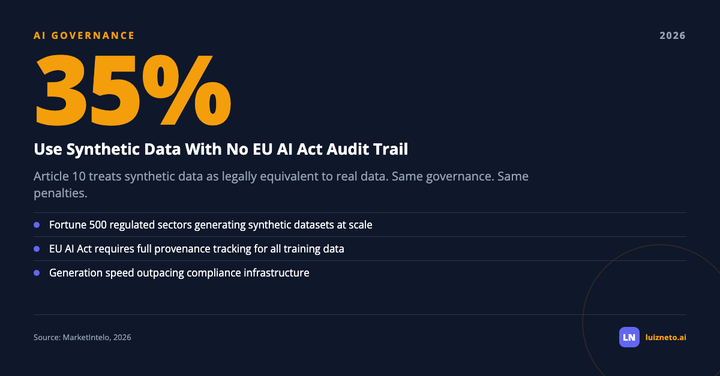
35% use synthetic training data with no EU AI Act audit trail. The enforcement just arrived.
Dev and Test Environments Are the Unguarded Door
Production gets the budget. Dev and test get the copies.
Only 4% of development and test environments are fully compliant with data privacy requirements (K2View, 2026). That is not 40%. Not 14%. Four percent.
The reason is structural. Compliance controls were designed for production databases. Access management, encryption at rest and in transit, audit logging, data classification. All of these tools assume the data stays in the production environment. When 87% of organizations copy sensitive data into non-production systems, the controls do not follow.
Legacy data masking processes compound the problem. 85% of enterprises suffer slower release cycles because of manual, batch-oriented masking workflows (K2View, 2026). Development teams need fresh data to test against. Masking is slow. So teams bypass it. They pull production copies directly into staging and test environments. The sensitive data follows.
76% of enterprises had a sensitive data incident in non-production environments within three years. Three-quarters of the market. And the non-production environments are where GenAI gets most of its data, because that is where the experimentation happens.
Enterprise B solved this differently. It replaced batch masking with continuous synthetic data provisioning. Every non-production environment gets a synthetic copy that preserves referential integrity and statistical distributions. The production data never leaves production. Release cycles are faster because developers never wait for a masking batch to complete.
Enterprise A is still debating whether synthetic data is realistic enough. Meanwhile, its production data sits in 55 environments with no technical controls and no verification.
When the incident happens in a non-production environment, the playbook does not exist.
The 4-Step Synthetic Data Compliance Framework
The enforcement chain has four links. Each link needs one action. None of them is optional, and the order matters.
Step 1: Map where sensitive data lives beyond production.
You cannot protect data you cannot find. Deploy automated discovery tools that scan data lakes, NoSQL databases, flat files, and analytics environments. Continuous scanning, not quarterly audits. The goal is 100% discovery confidence across every environment type, not just the SQL databases where 88% of enterprises already feel confident (K2View, 2026). Focus on the 9% confidence zones: data lakes, unstructured storage, shadow AI environments.
Step 2: Deploy technical controls at the GenAI boundary.
A policy engine between your data infrastructure and your GenAI tools. Every query to an LLM passes through a control that detects sensitive fields and either masks them, substitutes synthetic records, or blocks the request. This is the link where 87% of enterprises fail. The control must be automated, not manual. It must intercept data at the pipeline level, not rely on employees to self-police.
Step 3: Adopt synthetic data with decision-grade validation.
Synthetic data adoption stalls because enterprises cannot measure whether the synthetic output is good enough. Use a quality framework like Burke's FAR to evaluate Fidelity, Authenticity, and Resolution before deploying synthetic records into decision pipelines. Set quality thresholds per use case: development and testing can tolerate lower fidelity than analytics and model training. For non-production environments, synthetic data that preserves referential integrity is sufficient. For AI training, validate against downstream task accuracy.
Step 4: Build audit trails that satisfy Article 50 now and Article 10 in 2027.
Every synthetic dataset needs provenance documentation: what real data it was derived from, what generation method was used, what quality metrics it achieved, and when it was created. Article 50 compliance requires machine-readable marking of AI-generated content. Article 10 compliance (December 2027) will require documentation proving training and test datasets are relevant, representative, and free of errors. Build the audit trail now. Retrofitting it later costs more and covers less.
| Step | Action | Evidence | Deadline |
|---|---|---|---|
| 1. Map | Automated sensitive data discovery across all environments | 9% discovery confidence in data lakes (K2View, 2026) | Immediate |
| 2. Control | Policy engine at GenAI boundary | 13% have controls; 87% rely on policy alone (K2View, 2026) | Immediate |
| 3. Adopt | Synthetic data with FAR-grade quality validation | 79% stalled on realism; 80% accuracy / 60% false conclusions (Burke, 2026) | Q4 2026 |
| 4. Audit | Provenance tracking and regulatory documentation | Article 50 live Aug 2026; Article 10 Dec 2027 | Dec 2027 |
Sources: K2View, 2026; Burke, 2026; EU AI Act
The cost of each step is measured in engineering effort. The cost of skipping them is measured in fines, incidents, and the regulatory scrutiny that arrives in December 2027. Enterprise B invests in the chain now. Enterprise A discovers the missing links during an audit.
Frequently Asked Questions About Synthetic Data Compliance
Is synthetic data compliant with GDPR?
Synthetic data that cannot be linked to real individuals generally qualifies as anonymous under GDPR. However, the IEEE White Paper "Toward Practical Anonymity" (2025) notes there is no universal legal standard for synthetic data anonymity. Enterprises should validate with privacy risk metrics and adversarial threat modeling before claiming GDPR exemption.
What are the EU AI Act requirements for synthetic data?
Article 50 requires machine-readable marking of AI-generated content, enforceable since August 2, 2026, with fines up to €15M or 3% of global turnover. Article 10 governs training and test data governance for high-risk AI, deferred to December 2027. Both affect how enterprises use and document synthetic data.
How do enterprises protect sensitive data in AI environments?
Only 13% deploy technical controls preventing sensitive data from entering GenAI systems (K2View, 2026). Effective controls include automated data masking at the pipeline level, synthetic data substitution for non-production environments, and policy engines that intercept queries between users and AI tools.
What is the difference between data masking and synthetic data?
Data masking alters real data values while preserving structure. Synthetic data generates entirely new records that mimic statistical patterns without containing real data. Masking is faster to deploy but carries residual re-identification risk. Synthetic data eliminates the link to real individuals but faces realism concerns: 79% of enterprises cite accuracy as the primary barrier to adoption (K2View, 2026).
Why do enterprises struggle with synthetic data adoption?
79% cite realism and accuracy concerns. The Burke FAR Framework (2026) confirmed LLM-generated synthetic data reaches 80% accuracy but produces false conclusions in 60% of business scenarios. The core problem is measurement: enterprises lack standardized quality benchmarks to validate synthetic output against specific decision requirements.
What Comes Next
Article 10 enforcement arrives in December 2027. The enforcement chain that breaks today will face regulatory scrutiny in 16 months. Every enterprise using production data in AI training and testing environments will need to document how that data was governed, what quality standards it met, and whether it was representative and free of bias.
The organizations closing the 98-to-13 enforcement ratio now will own the compliance advantage when that deadline lands. They will have discovery tools running continuously across every environment. They will have technical controls at every GenAI boundary. They will have synthetic data pipelines validated against decision-grade quality frameworks. They will have audit trails that satisfy both Article 50 and Article 10.
Enterprise A will start then. Enterprise B started already.
The enforcement chain has four links. Which ones are you missing?
Get the weekly AI governance briefing delivered to your inbox so you can track the compliance landscape as Article 10 approaches. Subscribe here.